
Table of Contents
Macro Context: Energy Transition as a Risk Phase
Venezuela energy transition petrodollar dynamics show that the global energy transition cannot be viewed as an easy substitution of fossil fuels for renewable alternative resources; instead, it should be interpreted as a structurally unstable intermediate period where value-added energy systems remain necessary and continued use of older forms of energy is required until newer forms can be scaled up and trust is built in their ability to meet on-demand requirements safely. Oil continues to be utilized throughout the supply chain due to its essential nature in transportation (motor vehicles, trucks, planes), heavy industry (iron, steel, cement), petrochemicals (most plastics) and as a complement to renewable energy resources (solar and wind) to balance electricity loads on the electrical grid.
Therefore, the transitional nature of our energy sector results in provoking buyers’ panic when oil supply is disrupted, causing upward price shifts, and inflation and lower growth expectations. Factors such as underinvestment in the development of upstream oil capacity, fracturing of the previously fluid nature of the global supply chain through geopolitical events, implementation of sanctions-based supply chain models (e.g., sanctions formerly imposed on Iranian oil exports) and reduced levels of spare production buffers collectively increased the sensitivity of the global economy to marginal shifts in oil supplies. Thus, energy markets during this time will be characterized less by abundant or scarce supplies and more by volatility and timing. Price stability will become a primary macroeconomic focus for governments rather than a byproduct of the market.
Fossil Fuel Dominance ─────▶ Transition Volatility ─────▶ Renewable Stability
(Stable) (High Risk) (Future)
↑ Oil control is most critical here

Venezuela’s Strategic Importance
Due to the size and characteristics of its reserves, as well as its location, Venezuela has a distinctive advantage in the global energy market. Although Venezuela has the largest amount of crude oil reserves on earth, it has not been able to produce at levels comparable to its potential due to sanctions, political instability, and an inability to restore the country’s energy sector. In contrast to mature oil producing countries that have matured and are producing close to their maximum, Venezuela essentially has an unlimited potential supply of crude to offer. The abundance of this type of potential supply is especially valuable during energy market crises when there is little spare capacity in the industry, and very little investment has occurred in the upstream portion of the industry. Additionally, because of the geographic advantages of being located in such close proximity to the U.S. refineries and shipping lanes in the Atlantic, Venezuela is more closely aligned with the American energy market than many other countries with potential oil supplies; therefore, transportation issues will not be as great an impediment to accessing Venezuela’s oil as they are many other producers. Consequently, rather than being simply another oil holder, Venezuela may be seen as a swing producer that could have a significant influence on energy prices during times of disruption.

Venezuela is not only important for its physical supply of oil but also for its global systemic and financial significance. The prolonged economic sanctions against Venezuela have caused the Venezuela oil trade to operate outside of the traditional Western financial and settlement systems; it has encouraged various ways to experiment with non-dollar transactions, barter systems, and bilateral energy agreements with competing countries. Thus, Venezuela’s oil trade serves as a testing ground for new types of frameworks for post-dollar oil trading while the current global monetary system has already begun to undergo tremendous pressure. If replicated, these types of trade relationships erode pricing discipline, erode the credibility of sanctions, and accelerate the fragmentation of global energy economies based on geopolitical lines. Therefore, Venezuela’s oil is not only a commodity risk; it is also a monetary risk and governance risk. A control of the production, price structure, and alignment of the oil trade with the buyers directly influences cycle inflation, the confidence and trust in the currency and the overall financial stability of the world during the ongoing energy transition process; as a result, Venezuela’s position has changed from a regional concern to a critical global strategic node in the management of the international economy.
Petrodollar System Overview
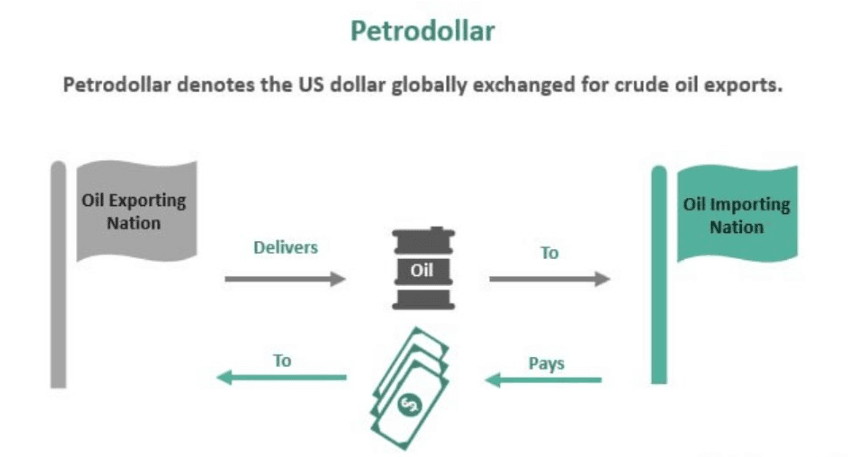
The Petrodollar System, very literally, means a way to account for and measure the purchase of oil globally using the dollar as currency. Over the past decade, the Petrodollar System has provided a mechanism for creating demand for dollars globally. The importance of energy markets is so large because energy is an essential input for every economy. Therefore, in order to participate in the Global Energy Trade, countries are incentivized to keep dollars, purchase dollar-denominated investments, and utilize U.S.-centric payment systems. As a result, the Petrodollar System enables the United States to fund large ongoing budget deficits and trade deficits with minimal impact on the value of the dollar or the global confidence in the dollar as a stable currency. Therefore, while it may appear that the Petrodollar System will continue to exist as long as there is demand for oil, it will be based upon the fact that all oil pricing is done in a disciplined manner and no scalable alternatives exist to allow for the purchasing and selling of oil without the dollar.
How the Energy Transition Threatens the Petrodollar
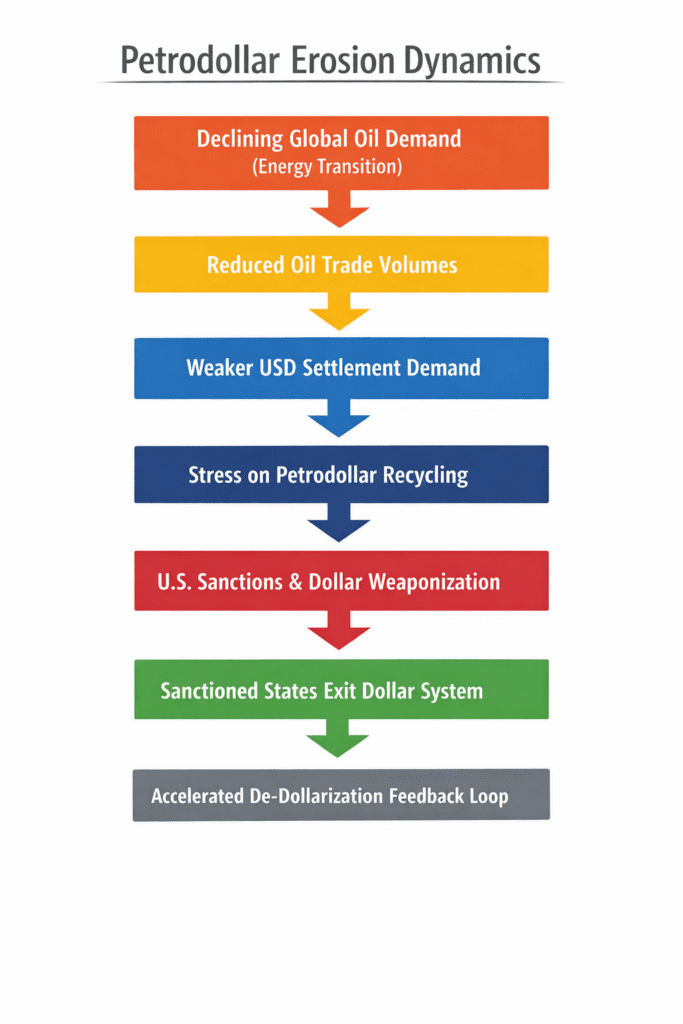
There are multiple threats to the dominance of the dollar as the primary currency used for international trade because of the energy transition to renewable sources. This transition will cause the mechanisms that enforce the dollar’s dominance globally to weaken as countries move away from purchasing oil to using renewable sources.
These sources are more likely to be generated locally and therefore will not require settlements in dollars for the international trade of energy. Additionally, with oil prices declining in the long-run, and therefore the certainty of long-term contracts decreasing, producers will be less likely to recycle their surplus cash into U.S. markets, resulting in decreased liquidity in the dollar market. Concurrently, competing powers are utilizing this interim time period by actively promoting bilateral energy trading arrangements that could ultimately undermine the dollar’s usefulness and market value. Ultimately, the dollar’s use in international transactions will continue to decrease due to decreased demand for it, as well as increased competition from other currencies and markets.
As a result, we should expect to see a gradual erosion of the dollar’s value through lower levels of reserve accumulation, fragmented pricing, and reduced effectiveness of economic sanctions rather than an outright collapse of the dollar system. Due to inflation sensitivity, supply shocks, and geopolitical tensions in a transitional environment, anything less than complete petrodollar leakage will magnify the effects of any partial leakage and create an environment in which the petrodollar system is at its most vulnerable, not at the end of the fossil fuel era, but at the intersection of a transitional environment and where oil is still an important commodity but contested both politically and financially.
Venezuela as a Petrodollar Pressure Point
Venezuela is considered to be a structural pressure point in the global petrodollar system. They have substantial reserves of oil and have a long-standing history of using non-dollar methods of settling oil sales, which pose a substantial challenge to the dollar-denominated structure of the petroleum business worldwide.
Venezuela has approximately 303 billion barrels of proven crude oil reserves, making it larger than Saudi Arabia, which, combined with its historical patterns of production, creates the opportunity for Venezuela to be one of the largest swing producers in the world and to be able to affect global oil flows during the transition to alternative forms of energy. Under the ruler Nicolas Maduro, Caracas has implemented new methods of exporting crude oil, including using non-dollar mechanisms such as the yuan and other currencies to avoid the impact of U.S. sanctions on its oil exports. Caracas has also begun to test using digital asset payments in lieu of U.S. dollars as a means of circumventing the U.S. sanctions and correspondent banking constraints, essentially creating its own alternative settlement infrastructure that is separate from dollar-centric channels.
The transformation indicates a weakening of two vital components of the petrodollar: First, the requirement that oil transactions take place only through the U.S. dollar and second, the reinvestment of petrodollars back into the U.S. financial system, which has been the foundation of U.S. Currency supremacy for decades. On a larger, more international level, the fact that Venezuela has begun doing oil trade with countries outside of the dollar-based system means that other nations competing against the U.S. will copy Venezuela’s model, and could lead to increasing levels of de-dollarization throughout the global energy marketplace. Analysts have mentioned this as one of the key strategic reasons for the foreign intervention and external pressures directed at attempting to re-establish the Venezuela oil trade back under the U.S. dollar settlement and the control of the U.S. Government.
Trump’s Strategic Logic
Examining the reasoning behind President Trump’s decisions with respect to Venezuela can best be achieved by understanding him not as a reactive decision-maker, but rather as a probabilistic risk manager within an ever-evolving global macro-geopolitical context. In doing so, it is important to understand Trump’s reasoning as consisting of three related “strategic probabilities” associated with his actions concerning Venezuela:
(a) The probability that continued uncontrolled Venezuelan oil trade outside of dollar settlement will accelerate the de-dollarization of global economies;
(b) The probability that inflationary shocks created as a result of unstable energy markets during this transition period will adversely affect the macroeconomic stability of the United States; and
(c) The risk that competing international powers can use Venezuelan energy resources infrastructure to develop their own resources within the Western Hemisphere, thereby creating greater competition for U.S. access to these resources.
Collectively, these considerations, which represent a realpolitik view of the issues surrounding Venezuela, support Trump’s approach, which continually emphasises and continues to emphasise the domestic economic implications (stability of energy prices, monetary stability of currencies, and inflation control) on a short- to medium-term basis. Under this analysis, Venezuela is a transitional petro-state transitioning into a systemically critical country, as it can materially impact the viability of the United States’ Petrodollar.
Therefore, although at first Trump was perceived to be attempting to seize Venezuelan oil assets forever, in reality, he was using a probabilistic hedging approach whereby gaining control over the manner in which Venezuelan oil is produced and settled decreases the opportunities for a number of negative consequences to stem from any increase in energy prices, including inflationary shocks to the world economy, fragmentation of demand for the global reserve currency and the development of energy alliances using currencies other than the U.S. Dollar.
This reasoning helps to clarify the series of policies implemented by Trump, which were designed to provide him with maximum bargaining power (through the use of sanctions, diplomatic isolation and covert pressure) while preserving the ability to adjust policy positions (policy flexibilities) as the international marketplace and geopolitical alliances were changing in real-time. Ultimately, Trump’s policy decisions fall into a nested probability framework where minimization of systemic de-dollarization is expected to be achieved, simultaneously as maintaining domestic macro-economic stability and restricting the ability of rival nations to create and institutionalize alternative energy-currency networks.
Core Strategic Synthesis
Venezuela is experiencing increased external pressure because the United States and other advanced economies are leveraging their financial systems within the context of a widespread and growing strategic initiative to assess and manage systemic risk during this volatile time of transformation in the global energy and monetary system. The energy transition provides a platform where oil has lost its long-term primacy, yet simultaneously has created conditions for oil prices to be unstable, thereby causing political instability and inflation to occur. The transition has resulted in greater demand for controlling remaining flexible assets in the short term (i.e., oil); the transition also creates the need to stabilize the Petrodollar system as the petrodollar becomes weaker due to rising demand for alternative currencies (e.g., the euro or yuan).
As such, Venezuela finds itself in a unique position of being one of the largest underutilized oil reserve holders, where it can have an influence on marginal supplies while simultaneously being subject to severe sanctions, and so experimenting with the establishment of new non-dollar energy trading frameworks. When this is examined through the lens of probability and realpolitik, it can be seen that President Trump’s strategy does not focus on securing dominance over oil, but instead on minimizing the chance of negative systemic outcomes; these include: energy-driven inflation shocks; the accelerated loss of USD dominance; and rival geopolitical entrenchment in the Western Hemisphere.
The strategy that emerges therefore emphasizes maintaining control, maximizing optionality, and creating leverage over an ideology or any long-term commitment to addressing climate change. The overall goal of President Trump’s strategy is to ensure stable prices, maintain the credibility of the USD, and preserve macro-financial dominance until such time that the current energy transition process can be completed without causing economic dislocation and the loss of strategic power.
Final Summary
As oil becomes less important to the global economy, Venezuela plays an important, yet temporary, role. Although oil is still very valuable and new forms of energy have not yet developed, controlling Venezuela’s oil production allows market participants to stabilize prices globally and limit inflation. Controlling production also supports the dollar’s place as the primary means of exchange for oil during this period of transition. Venezuela’s ability to control production and sell oil provides leverage on a geopolitical level until the world fully transitions to a new energy system. In essence, Venezuela buys us all time until there is a new energy order.
Sources & References
- International Energy Agency (IEA) – World Energy Outlook
- S. Energy Information Administration (EIA) – Venezuela Country Analysis
- BP Statistical Review of World Energy
- OPEC Annual Statistical Bulletin
- IMF World Economic Outlook
- World Bank – Global Economic Prospects
- Council on Foreign Relations – Venezuela & Energy Geopolitics
- Brookings Institution – Energy Transition and Global Power
- Federal Reserve Economic Data (FRED) – Inflation & Dollar Liquidity
- Reuters & Bloomberg – Venezuela oil trade and sanctions coverage
- S. Treasury (OFAC) – Sanctions Reports
