Price Ceiling vs Price Flooring in India helps us understand how the government affects Prices, Producers, Consumers through Pricing Policy.
Governments impose price controls to help ensure that basic necessities are kept at an affordable level and provide a safety net for producers (especially in profit-driven industries). An example would be the agricultural industry (where price control ensures farmers are not overcharged) and food distribution sectors (where price ceiling helps cities maintain lower levels of hunger).
Price ceilings and price floors are price controls that are imposed by government. A price ceiling is a maximum allowable price, while a price floor is a minimum allowable price. Price ceilings protect low-income consumers from immense increases in prices on specific goods or services (i.e.: rent) with set price caps in the marketplace, while price floors protect farmers or producers from economic difficulties as a result of reduced prices for their products. The implementation of price ceilings creates scarcity of goods or services and the emergence of a black market as a result of excessive demand, while price floors create surpluses of goods and services and the wastage of resources as a result of insufficient demand. All in all, price ceilings provide a measure of price control for consumers and price floors provide a measure of price control for farmers or other producers.
Price controls are often applied to staple goods in India. By law the government can cap prices or stock levels of essentials under the Essential Commodities Act (ECA), and sets minimum purchase prices for many farm crops. These interventions are intended to achieve equity and stability, but they inevitably distort market outcomes.
Rationale for Price Controls
Economists explain that governments place “price control” to provide affordability for basic goods, as well as limit inflation, create stability in the market, and provide assistance to vulnerable groups within society. In the case of food prices, if they increase a large amount and dramatically exceed consumer purchasing power; the price ceiling creates protection for consumers against “price gouging”. As a result, food becomes affordable to low-income families. Conversely, if commodities fall drastically in value; a price floor guarantees that farmers receive a fair price for their produce and can continue to grow food. Economists describe that when supply and demand are in balance through normal circumstances; people create price “controls” and disrupt the normal cyclical nature of supply and demand. The theory behind economics is that price “control” allows for the “consumer to be protected during times of crisis and prevents monopolisation of markets by large corporations and protects the small producers and workers within them”. However, Economists also provide caution that, over time, short-term price control systems will create unintended consequences such as “shortages, surpluses and lower quality products”.
The Government of India executes a number of price control policies on key agricultural goods and essential products. These policies have two purposes: to offer food security to low income, poor individuals, as well as to provide farmers with a minimum income. These policies provide for both affordable retail prices through price rationing, as well as for minimum guaranteed rates via price support programs. There is often conflict between the two policy objectives in that, in order to provide higher guaranteed prices to farmers, the government must offset those costs through procurement which will lead to a consequent increase in retail food prices. The Government attempts to reconcile this tension through purchasing from farmers and through financial incentives or subsidies.
Price Controls in India: Mechanisms and Policies
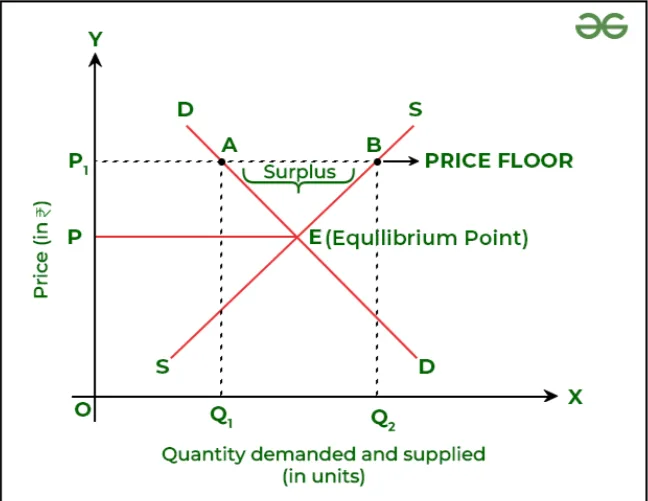
Minimum Support Price (MSP) is India’s most popular price floor. It is a price at which the Government of India guarantees that it will purchase certain crops. Each season the Commission for Agricultural Costs and Prices (CACP) sets and the Government approves MSPs for about 24 different crops, including; wheat, rice, pulse crops, oilseeds and cotton. The primary purpose of the MSP is to “prevent farmer loss of minimum profit,” by encouraging food staple production for National Food Security. If the market price for a crop falls below the MSP, the Government of India through its agencies (FCI, NAFED and state agencies) purchases the crop at the MSP, thus enforcing the MSP price floor for that crop. Based on the MSP operations, grains will be supplied to the Public Distribution System (PDS) so that many poor people can receive subsidized foods.
FRP is the official minimum price that the government sets for farmers to sell their sugarcane, and it is enforced by sugar mills. In 2023, it’s changed to ₹315, a price increase from ₹305. In 2022/23, this minimum price will encourage more farmers to grow sugarcane instead of other crops and maintain a good amount of sugar production in the country. As it is the case with many crops on the Indian subcontinent, this minimum price is legally binding and state governments are allowed to set an additional minimum price for them. Therefore, it creates an obligation for mills and the Government of India to manage and control the size of sugar surplus and the amount of sugar that mills can export.
In short, the Essential Commodities Act 1955 provides the Government of India with broad powers over the production, supply and pricing of essential commodities, or items deemed necessary for meeting basic consumption needs (this includes food). The act allows the Centre to do things like impose storage limits, maximum sale prices, etc. However, these regulations are generally only applied to specific commodities, such as cereals, pulses, onion, potato, oil; therefore, if there is an increase in onion prices, the government has the power to stop exports, impose storage restrictions on traders selling onions, and provide subsidized onion stocks to consumers. Furthermore, these actions by the government are essentially price capping mechanisms that cap retail prices or limit the amount of supply available to consumers, thereby helping reduce the excessive increase in onion prices.
The PDS (Public Distribution System) in India is an example of how the government uses its Food Subsidy Programme in conjunction with price control policies. As part of this scheme, the government purchases essential food items known as Staple Commodities (Rice, Wheat, etc.) at a Minimum Support Price (MSP), then distributes them to those in need through chains of ration stores at a low selling price (amounting to ₹2 – 3kg for rice/wheat). The subsidization of foodstuffs is viewed as an extension of the above pricing policy, normally to conservatively encourage the consumption of food by very poor households (farmers) who would otherwise not be able to afford it at market prices, however, as demonstrated by the budgetary information for FY 2023-24, the expenses associated with providing food to families and farming inputs/food fertility (i.e. subsidising staple food prices via the PDS or MPS) is estimated to constitute about one-eighth of total Union Government Resources.
Case study: Delhi farmers’ protest (2020–21) and price floor (MSP)
The protests by farmers against the Indian Government’s three Farm Bills during 2020/2021 is a clear example of how the fear of a Price Floor Policy impacts Indian Agriculture immediately. The establishment of three Farm Bills to create a more ‘free market’ environment for the sale and purchase of Agricultural Products resulted in mass protests by Farmers in Delhi as Farmers felt that such a move would undermine the current Minimum Support Price (MSP) System for crops such as Wheat and Rice which are the backbone of India’s Agricultural Sector. The Farmers’ concerns that Private Buyers would control the markets and thus reduce Government Procurement of goods at MSP drove Farmers to protest for over 4 months. The MSP is vital in maintaining price stability and providing Farmers with income security, particularly Small and Marginal Farmers, as it protects them from fluctuations in the Market Price of their products, as such the perceived loss of this income security led to prolonged protests until the repeal of the Farm Bills was accomplished, demonstrating how important prices are to the agricultural sector in India and to Farmer’s confidence and security.
Consequences of Price Ceiling
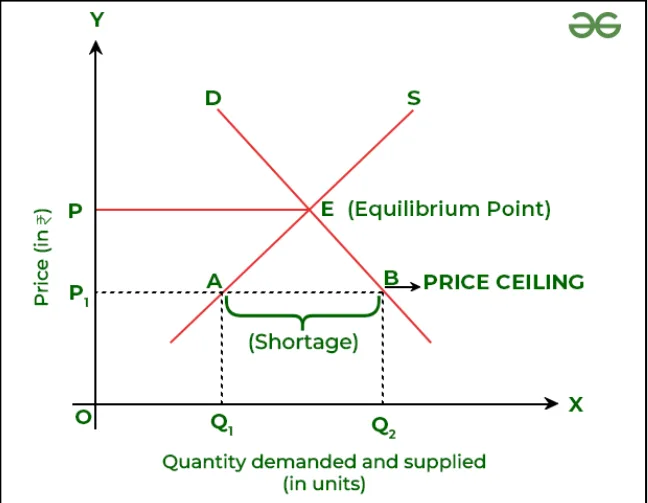
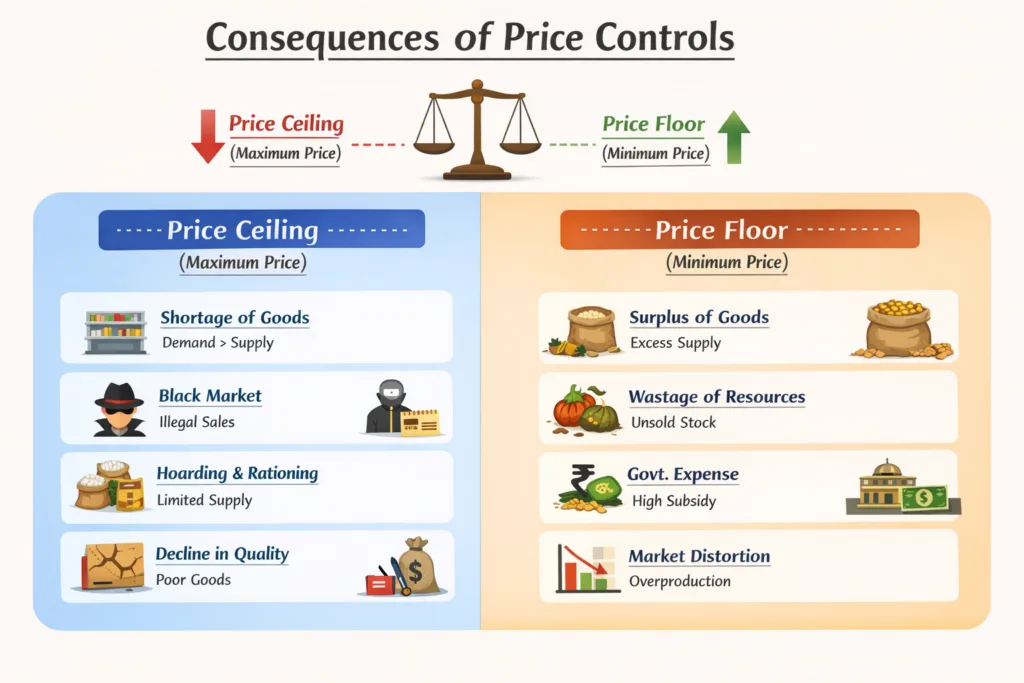
- An impractical level for a price ceiling compared to the market’s supply and demand leads to a higher quantity demanded at the ceiling price than supplied by suppliers resulting in a shortage of goods available for use.
- Black marketing has been on the rise due to the supply shortages leading to the illegal sales of goods for astronomically higher prices than the official ceiling prices set forth by government agencies.
- Hoarding and Rationing have begun as people have started stockpiling many types of products due to the absolute lack of available supplies, and governments have instituted Rationing systems as the only means to legally distribute the limited amount of products available to both businesses and consumers.
- The Quality of Products is declining because manufacturers cannot charge a higher price for their products; manufacturers have chosen to sacrifice product quality so that they can operate at a sustainable cost.
Consequences of Price Flooring
- A surplus exists when the floor is above the equilibrium price, which creates an excess of goods supplied compared to the quantity demanded.
- Agricultural surplus which cannot be sold will typically rot on the vine, and it creates economic waste in terms of unused resources.
- Governments are frequently obligated to purchase excess quantities through MSPs, which increases the government’s fiscal burden and the need for subsidies.
- A price floor creates a disincentive for diversification of products and results in the overproduction of certain items while distorting the normal market signals.
Bibliography
Mankiw, N. G. Principles of Economics. Cengage Learning.
Government of India. Essential Commodities Act, 1955.
Government of India. Minimum Support Price Policy – CACP Reports.
Indian Economic Survey (2023–24). Ministry of Finance.
NCERT. Introductory Microeconomics – Class XI.