
Hey there readers. Welcome to this special Markets edition from the Finance Flashcards wherein we dissect the much-awaited Union Budget. But before that, for the unversed..
The Finance Minister of India Nirmala Sitharaman presented the Union Budget for the FY27 in the parliament today. This was the ninth consecutive Union Budget presented by her under the current NDA-BJP regime, and the Markets remained volatile for the thick of it. The Volatility Index (VIX) spiked nearly 10% while the Indices were down in red, amidst investor uncertainty and mixed cues.
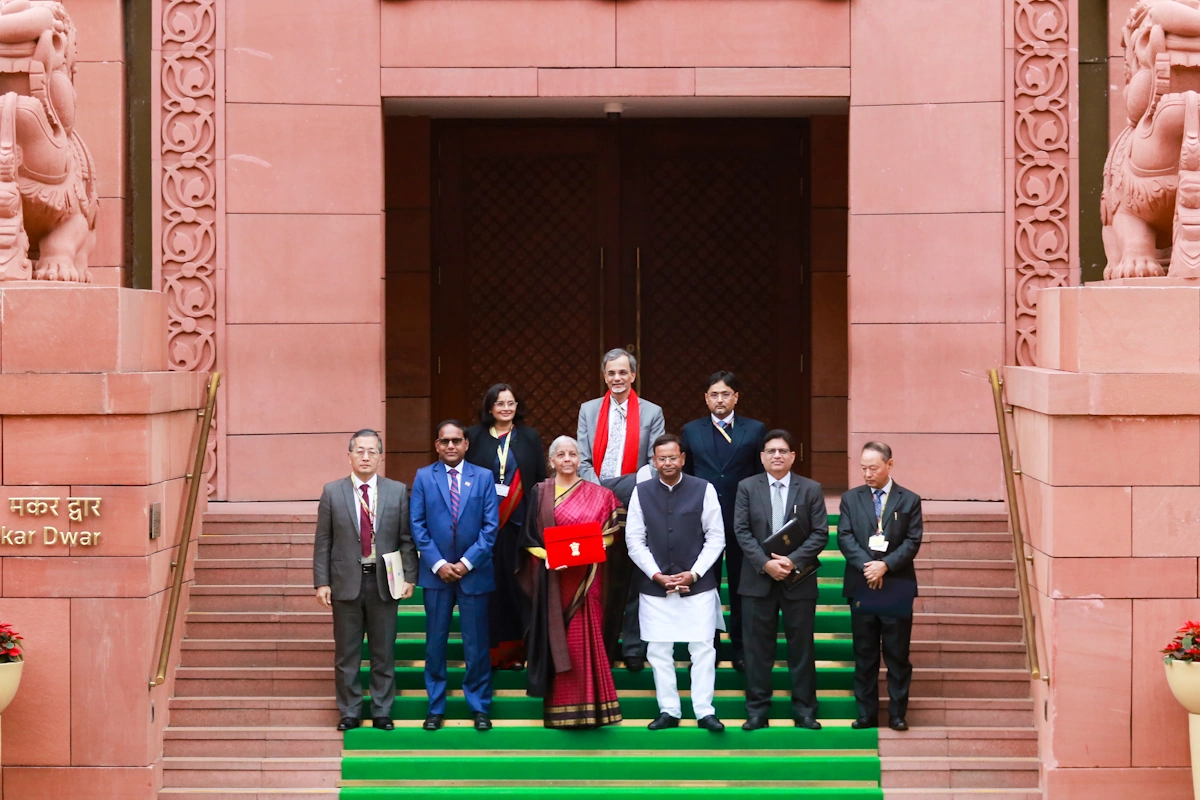
The Union Budget
Now we dissect and discuss the key takeaways for both investors and learners from the Union Budget for the year 2026-27, explaining key policies, reform-changes, announcements, and future projects/initiatives to be taken up by the Union Government, along with a LOT more.. stick around, this is going to be an insightful and interesting read.
India’s economic trajectory persists with and marches ahead with the belief “Viksit Bharat, balancing ambition with inclusion” aiming to transform aspiration into achievement and Potential into performance. The proposed Yuva Shakti-driven Budget highlights the Government’s ‘Sankalp’ – “To focus on poor, underprivileged and disadvantaged”.
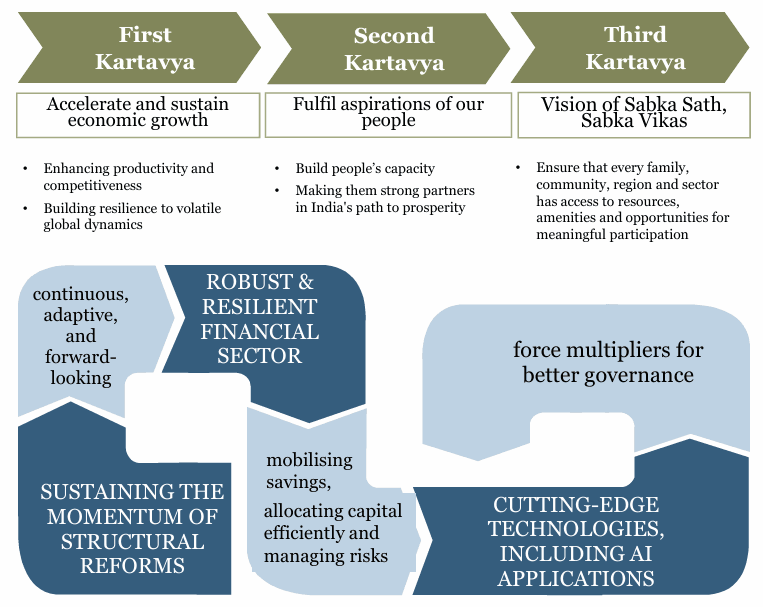
A look at the Sustaining Economic Growth
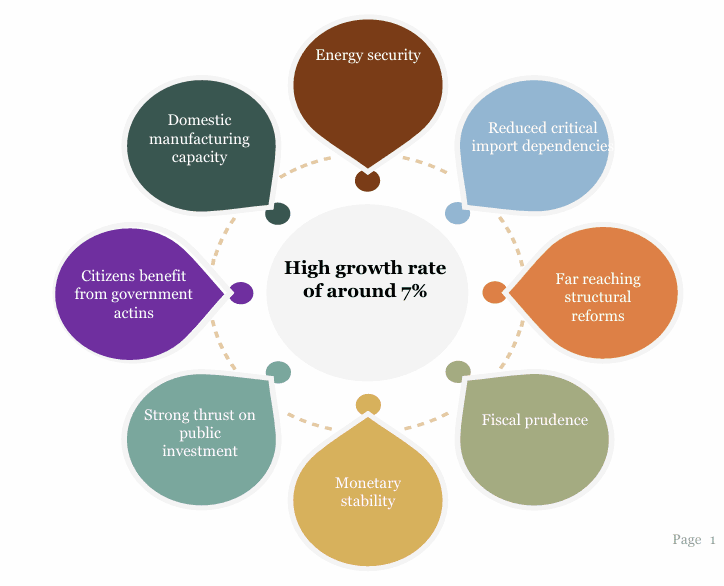
Some of the key highlights from the different sectors concerned to the growth ambitions include:
Manufacturing Sector
The Strategic and Frontier sectors lead the economic growth on the back of:
- India Semiconductor Mission (ISM) 2.0, building on the ISM 1.0 launched back in 2o21. Core objectives include Equipment manufacturing, Raw materials production, Stronger supply-chains, plus Research and innovation hubs, etc.
- Dedicated initiative for manufacturing of affordable sports and goods
- Integrated programs to revive and drive the Textiles
- Hi-Tech Tool Rooms in CPSEs (Central Public Sector Enterprises), aiming to support Micro-fabrication, Precision tooling, Electronics tooling and Defence grade components, etc.
- Biopharma Shakti, aiming to build India into a global biopharmaceutical manufacturing and research hub over the next five years.
and, many more..
Let us take a quick look at some of the major Tax Reforms to boost the Manufacturing Sector:
- Exemption from income tax for five years to non-residents providing capital goods, equipment or tooling, to any toll manufacturer in a bonded zone.
- Exemption from basic customs duty on components and parts used in aircraft manufacturing.
- Duty-free imports of specified inputs extended to export of shoe uppers in addition to leather or synthetic footwear.
- A special one-time measure to facilitate sale in domestic tariff area (DTA) at concessional rate of duty by eligible manufacturing units of SEZs (Special Economic Zones).
This in particular allows SEZs units to sell domestically without paying full tariff and customs duty as ‘outsiders’, subject to limit on export volumes. - Deferred duty payment window to trusted manufacturers.
These were some of the tax reforms under this sector, among others..
This is to go along with a Three-pronged approach to help MSMEs grow as ‘Champions’, as explained in the attachment below-
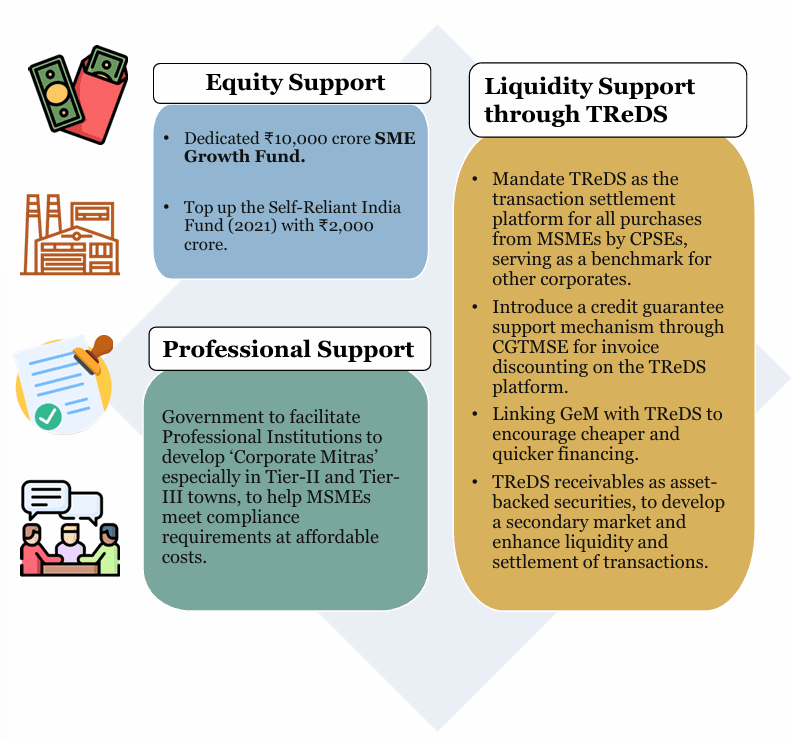
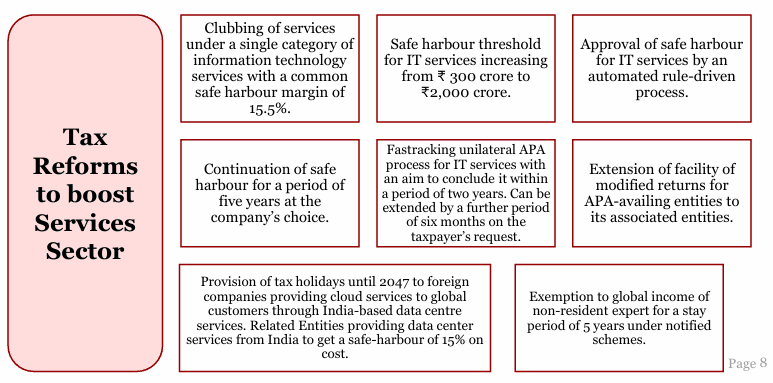
Emphasis on Services Sector
Some of the key initiatives include:
- High-Powered ‘Education to Employment and Enterprise’ Standing Committee to focus on the Services Sector as a core driver of Viksit Bharat.
- Under Health Services and Medical Tourism-
- Upgrade and establishing new institutions for Allied Health Professionals (AHPs) in ten selected disciplines.
- Schemes to support States in establishing Five Hubs for Medical Value Tourism in partnership with the private sector.
- 3 new All India Institutes of Ayurveda, upgrading AYUSH pharmacies and Drug Testing Labs for higher standards of certification ecosystem, & upgrading the WHO Global Traditional Medicine Centre.
- Khelo India Mission – integrated talent development pathway, systematic coaching development, integration of science & technology and development of sports infrastructure.
- Under Education, the major reforms include-
- 5 University Townships in the vicinity of major industrial and logistic corridors.
- A girls’ hostel in Higher Education STEM institutions in every district.
- Setting up or upgrading of four Telescope Infrastructure facilities.
- While for Tourism industry, the Budget focused on-
- Setting up a National Institute of Hospitality as a bridge between academia, industry and the Government.
- National Destination Digital Knowledge Grid to digitally document all places of significance.
- India to host the first ever Global Big Cat Summit.
- To develop ecologically sustainable Mountain trails, Turtle Trails and Bird watching trails in select states.
Financial Sector
Some of the tax proposals under the Finance Sector include-
- Incentive of ₹100crore for single issuance of municipal bonds of more than₹1000 crore. Current Scheme under AMRUT will continue.
- Restructuring Power Finance Corporation (PFC) and Rural Electrification Corporation (REC)
- Comprehensive Review of the Foreign Exchange Management (FEMA) (Non debt Instruments) Rules.
While the Tax reforms under this sector focused on raising the STT (Securities Transaction Tax) futures from 0.02% (currently) to 0.05%, and STT on options premium and exercise of options to be raised to 0.15% from rate of 0.1% and 0.125%, respectively.
Agricultural and Allied Sectors
To increase farmer’s income and enhancing productivity in this sector, key initiatives include-
- Dedicated programme for Horticulture – To Rejuvenate old, low yielding orchards and expand high-density cultivation of walnuts, almonds and pine nuts.
- Supporting High-Value Agriculture- Through Coconut promotion scheme to increase production, and promoting dedicated Indian Cashew and Cocoa programmes.
- Integrated development of 500 reservoirs and Amrit Sarovars, strengthening fisheries value in coastal areas, and enabling market linkages for start-ups.
- Integrating AgriStack portals and the ICAR package on agricultural practices with AI systems.
While Tax Proposals under this sector include-
- Fish catch by an Indian fishing vessel in Exclusive Economic Zone (EEZ) or on the High Seas to be made free of duty. Treating the landing of such fish on foreign port as export of goods.
- Deduction allowed to primary cooperative society engaged to include
supply of cattle feed and cotton seed produced by members. - Exemption from tax dividend income received by a notified national
co-operative federation from investments made in companies up to
31.1.2026 from tax for a period of three years. Exemption to be allowed
only for dividends distributed to its member co-operatives.
Strengthening Growth Foundations
Infrastructure
Several initiatives for large-scale enhancement of public infrastructure, including InVITs, REITs, NIIF etc. along with a focus on developing the infrastructure in Tier-2 and Tier-3 cities with over 5lakh population.
Some of the key highlights include-
- Setting up Infrastructure Risk Guarantee Fund to provide prudently calibrated partial credit guarantees to lenders.
- Operationalising 20 new National Waterways connecting mineral rich areas, industrial centres and ports.
- Launch a Coastal Cargo Promotion Scheme to increase the share of inland waterways and coastal shipping from 6% to 12% by 2047.
- Purvodya: Development of Integrated East Coast Industrial Corridor
Long-term energy security and stability
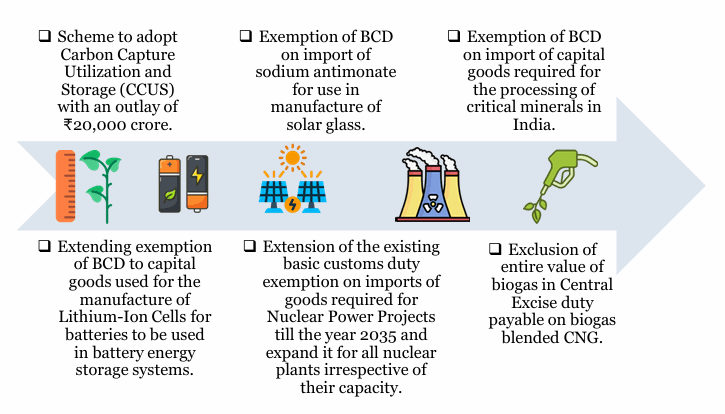
Urbanisation: City Economic Regions
Amplifying the potential of cities to deliver economic power of agglomerations, with particular focus on Focus on Tier-2, 3 Cities and temple-towns.
Alongside, a key announcement from the FM included- ‘Growth Connectors’ – 7 High-Speed Rail corridors between cities Mumbai-Pune, Pune-Hyderabad, Hyderabad-Bengaluru, Hyderabad-Chennai, Chennai-Bengaluru, Delhi-Varanasi, Varanasi Siliguri – Environmentally sustainable passenger systems.
People-centric development
Key initiatives and proposals include-
- Building a strong Care Ecosystem, covering geriatric and allied care services. Training of 1.5 lakh multiskilled caregivers.
- Self-Help Entrepreneur (SHE) Marts to be set up as community-owned retail outlets within the cluster level federations.
- Divyangjan Kaushal Yojana – providing dignified livelihood opportunities through industry-relevant and customized training specific to disability groups.
- Supporting Artificial Limbs Manufacturing Corporation of India (ALIMCO) to scale up production of assistive devices, invest in R&D and AI integration.
- Setting up of a NIMHANS-2 & upgrading National Mental Health Institutes in Ranchi and Tezpur,
among others..
Trust based Governance
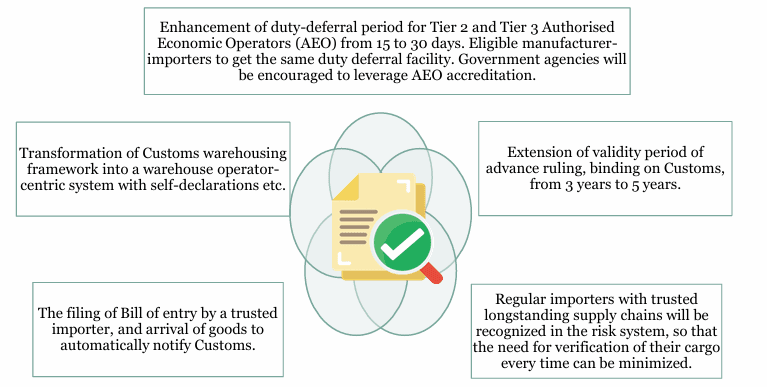
Ease of Doing Business and Ease of Living
Several announcements and proposals were made under this section, some of which featured as-
- Individual Persons Resident Outside India (PROIs) will be permitted to invest in equity instruments of listed Indian companies through the Portfolio Investment Scheme (PIS).
- Reduce TCS (Tax collected at source) for pursuing education and for medical purposes under the Liberalized Remittance Scheme (LRS) from 5% to 2%.
(FYI: LRS is an RBI framework allowing resident individuals to send money money abroad legally for permitted purposes, processed by the banks.) - Individuals with ITR 1 and ITR 2 returns will continue to file till 31st July and non-audit business cases or trusts are proposed to be allowed time till 31st August, and Time available for revising returns extended from 31st December to up to 31st March with the payment of a nominal fee.
- Tax buyback for all types of shareholders as Capital Gains. However, promoters will pay an additional buyback tax.
- Constitute a Joint Committee of Ministry of Corporate Affairs and Central Board of Direct Taxes for incorporating the requirements of Income Computation and Disclosure Standards (ICDS) in the Indian Accounting Standards (IndAS).
- Set-off using available MAT credit to be allowed to an extent of 1/4th of the tax liability in the new regime, with MAT (Minimum Alternate Tax) is proposed to be made final tax.
A look at the Fiscal Trends
Under the 16th Finance Commission–
- The Government has accepted the recommendation of the Commission to retain the vertical share of devolution at 41%.
- Provision ₹1.4 lakh crore to the States for the FY 27 as Finance Commission Grants. These include Rural and Urban Local Body and Disaster Management Grants.
Meanwhile, under Fiscal consolidation–
- Central Government will target reaching a debt-to-GDP ratio of 50±1 percent by 2030.
▪ The debt-to-GDP ratio is estimated to be 55.6 percent of GDP in BE 2026-27, compared to 56.1 percent of GDP in RE 2025-26. - In RE 2025-26, the fiscal deficit has been estimated at par with BE of 2025-26 at 4.4 percent of GDP. In line with the new fiscal prudence path of debt consolidation, the fiscal deficit in BE 2026-27 is estimated to be 4.3 percent of GDP.
Let us also take a look at..
The Deficit Trends
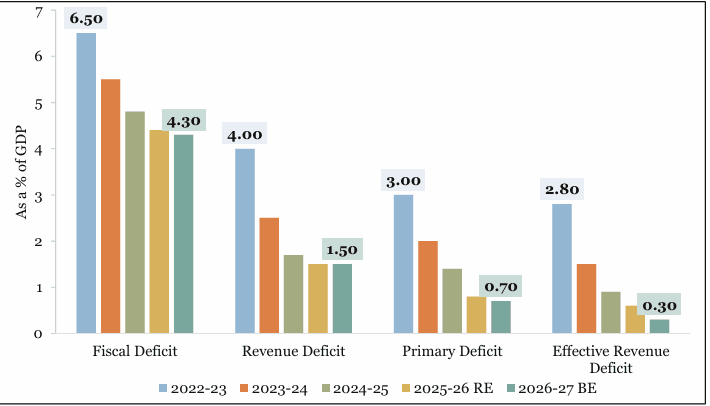
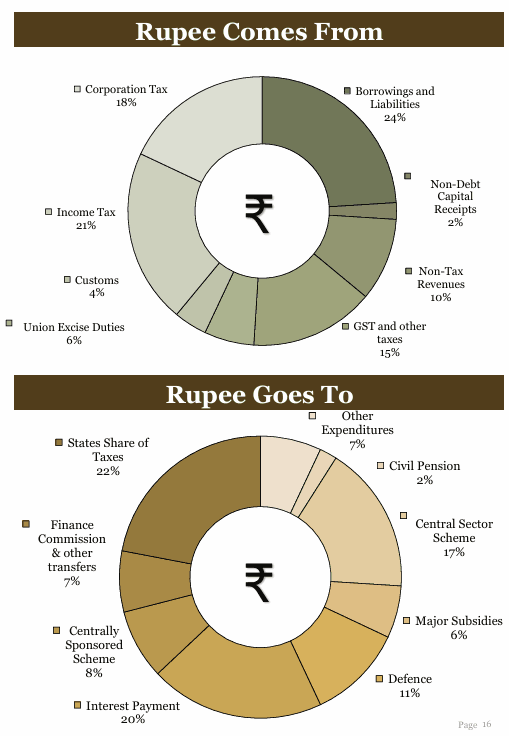
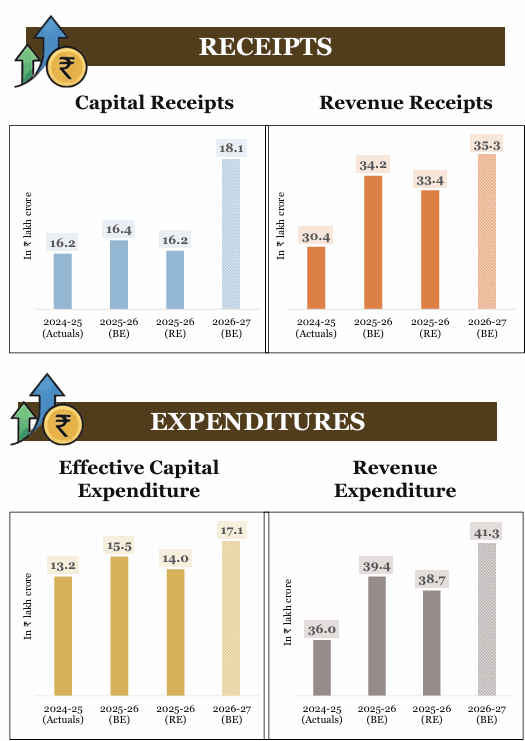
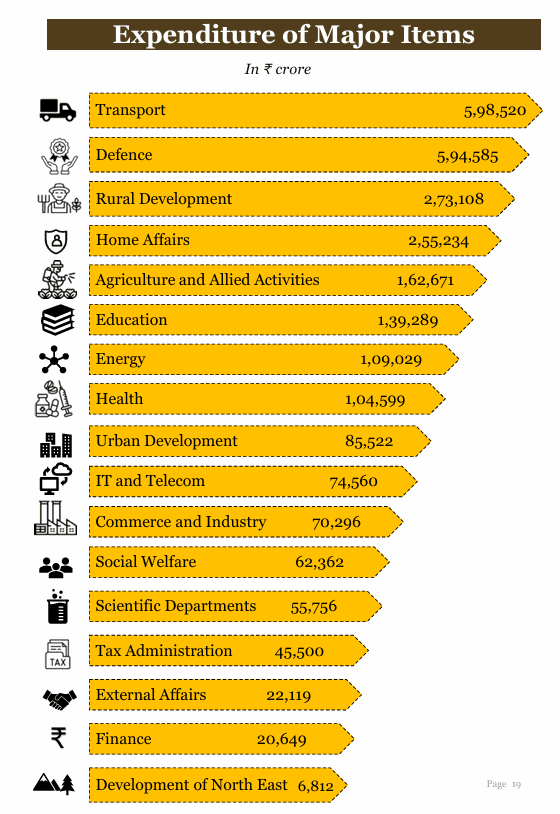
Some of the other important trends, and key data numbers are highlighted in the Union Budget are as under:
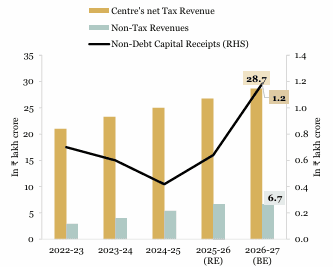
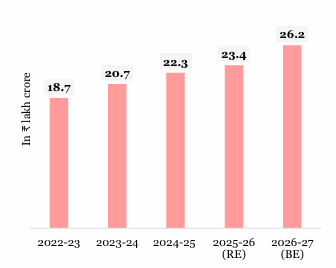
A look at the Robust Economic Foundations-
That’s all from our special Union Budget edition. Do share your thoughts and analysis of the Union Budget in the comments below. Stay curious..
PS: If you like the author’s work and contribution to this platform, and wish to discuss more related to Markets and Macroeconomics in particular, do follow and connect with me, or dm me on:-
LinkedIn @AnudityaGupttaa and, X @AnudityaGupttaa
Cheers.