
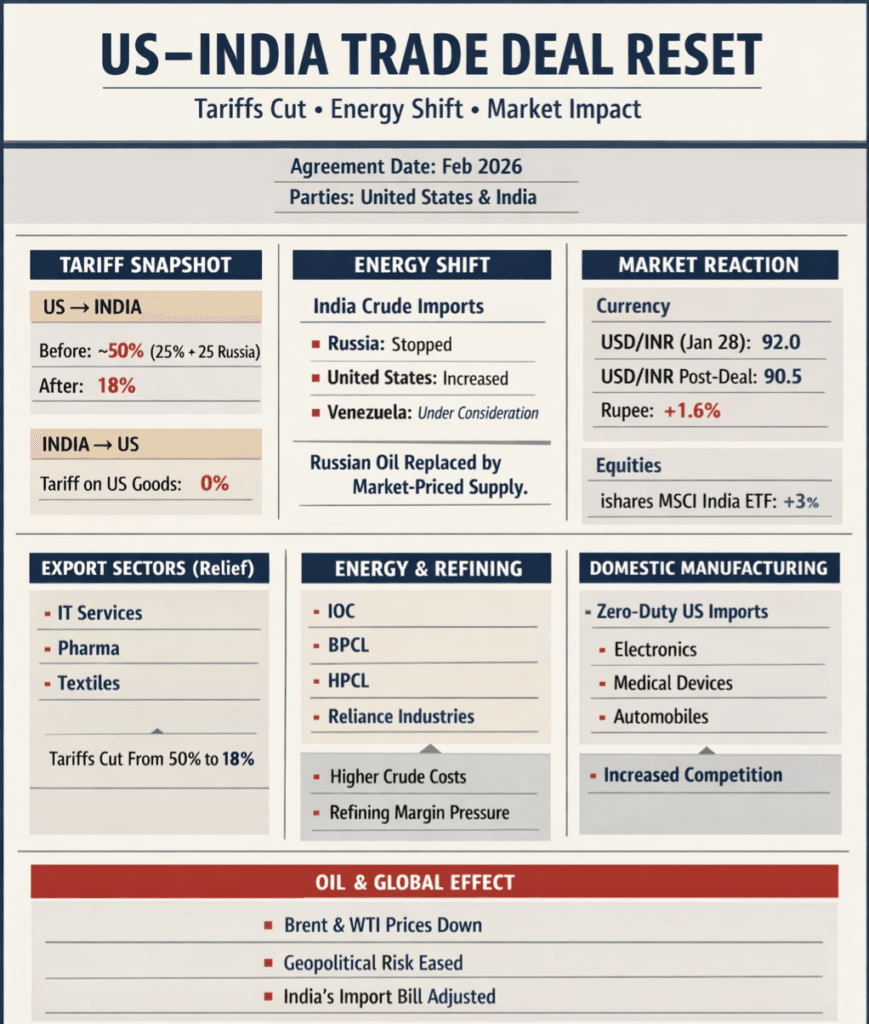
In a striking shift in global trade dynamics, President Donald Trump and Prime Minister Narendra Modi announced a landmark trade agreement on February 2, 2026. The accord caps months of tariff conflict and economic tension between the world’s largest democracy and one of its fastest-growing markets.
What’s in the Deal?
Tariff Restructuring
US tariffs on Indian goods: Cut to 18%, down from an effectively punitive 50% (previous 25% baseline + 25% tariff tied to Russia oil purchases).
Indian tariffs on US goods: Reduced toward 0%, with New Delhi committed to reducing duties and barriers on US products.
The tariff rollback is immediate and strategic — significantly easing trade frictions that had escalated sharply since mid-2025.
Energy and Trade Pivot: Ending Russian Oil Imports
A defining element of the deal is India’s pledge to halt or sharply reduce imports of Russian crude, which had been a flashpoint in negotiations — driving earlier punitive tariffs.
Shift in oil sourcing: India is expected to increase oil imports from the United States and possibly Venezuela as part of energy diversification linked to the deal.
This represents a significant geopolitical pivot, aligning India more closely with Western strategic priorities.
Immediate Market Reactions
Currency
The Indian rupee rebounded sharply, reversing recent weakness as risk premium from tariff uncertainty eased. (Local market sources report strengthening flows, although exact levels vary by exchange data and session.)
Equities
Indian and India-linked assets rallied:
Export-oriented stocks saw upticks in sentiment on the tariff news.
Broader markets, including ETFs like iShares MSCI India, moved higher following the announcement.
These moves reflect relief that the tariff escalation — which had already weighed on trade flows and capital markets — is being reversed.
Sectoral Impact Analysis
Export Sectors — Relief, But Structural Headwinds Remain
Sectors previously hit hardest by tariff escalation (e.g., textiles, leather, gems, and engineered goods) stand to benefit from the reduction from 50% to 18% duties. However:
18% remains a material cost compared with global competitors with lower duties.
Exporters may still face demand displacement unless supply chains gain pricing advantage post-deal.
Energy and Refining Margins
India’s refiners had benefited from discounted Russian crude. Exiting that supply to pivot toward US/Venezuela can:
Increase procurement costs.
Compress Gross Refining Margins (GRMs) unless offset by favorable long-term contracts or yield advantages.
Reliance Industries and state OMCs are among the most exposed.
Domestic Industrial Risk
Zero tariffs on US imports can open Indian markets to duty-free competition in sectors such as:
Electronics & medical devices
Automotive components
Capital goods
This runs counter to some Make in India objectives and may pressure local producers to accelerate competitiveness enhancements.
Strategic & Geopolitical Implications
This deal has wider global significance:
It marks a shift in India’s economic posture vis-à-vis Russia and the West, aligning New Delhi closer to US strategic objectives while preserving sovereign trade choices.
Trade negotiations and energy policy are now more deeply intertwined, setting a precedent for geopolitical trade linkages.
Analysts view this as part of an emerging multipolar trade architecture where strategic interests influence tariff and energy flows.
What Comes Next: Key Risks & Watchpoints
Tariff Implementation Nuances
Technical implementation of tariff reduction, certification of rules of origin, and dispute-resolution mechanisms will determine how fast benefits materialize.
Energy Market Volatility
Oil price swings and supply chain reconfiguration costs could offset gains from tariff relief.
Domestic Politics
Indian policymakers may face pressure to balance opening markets with protecting nascent industries.
The US–India trade agreement represents a major reset in economic relations:
Tariffs cut from punitive levels to a still-significant 18%, easing export bottlenecks.
India moves away from Russian oil imports, aligning energy policy with Western interests.
Markets reacted positively, but structural challenges remain for exporters, import-competing industries, and energy value chains.
This breakthrough is both a diplomatic milestone and a complex economic deal — one that sets the stage for deeper bilateral engagement while posing new challenges for Indian trade policy and industry competitiveness.