
After years of post-pandemic expansion, the Indian IT sector has entered a slower phase. Revenue growth has softened. Deal ramp-ups are taking longer. Hiring has become measured. And stock valuations have corrected as expectations reset. For an industry that contributes significantly to India’s exports, white-collar employment, and market capitalisation, this shift matters. But slowdowns in technology services are often cyclical — not structural. The key question is whether this is temporary caution or a deeper transformation.
To understand what’s really happening, we need to separate cyclical pressure from structural change.
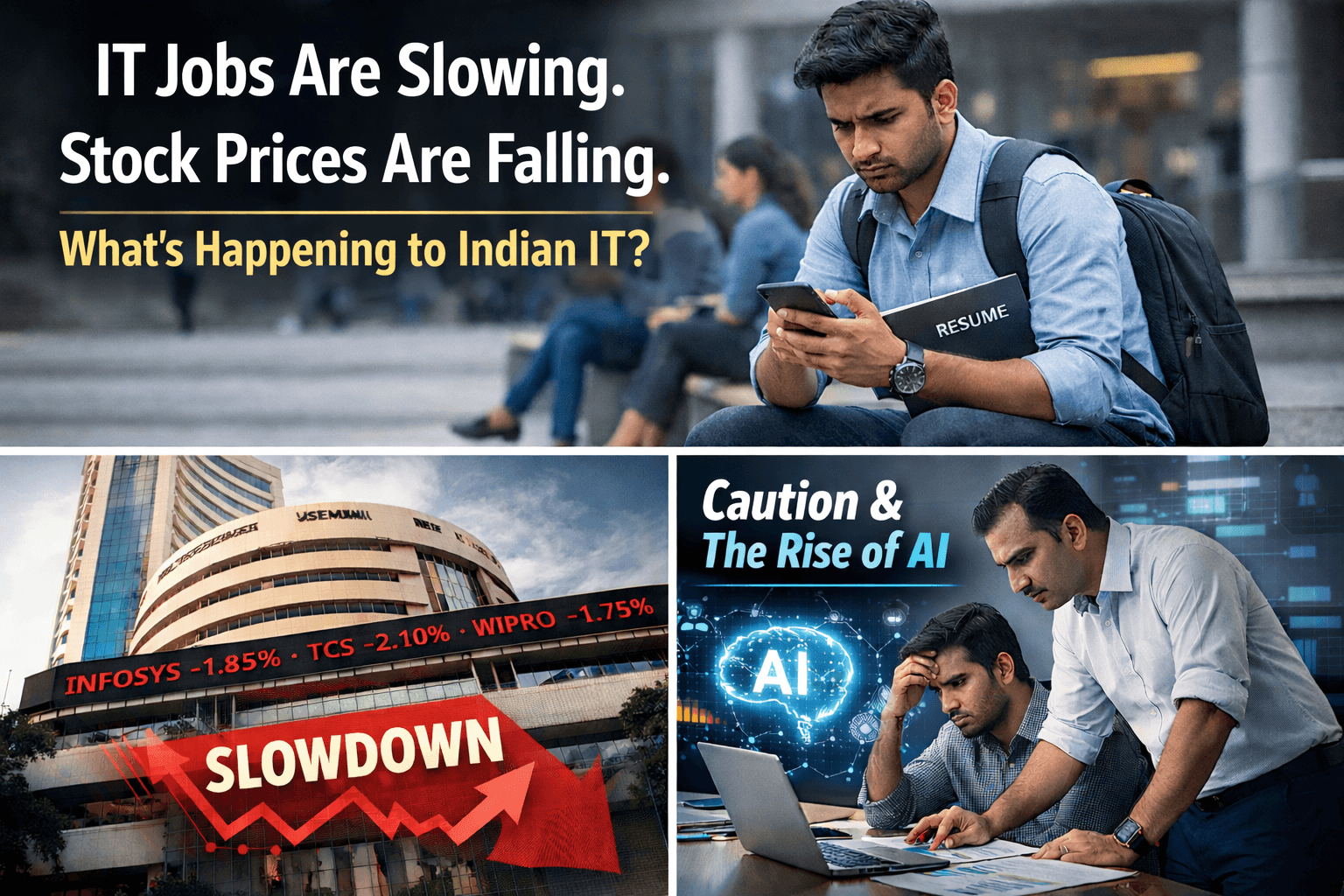
What’s Driving the Current Slowdown?
The weakness in Indian IT is not the result of one shock. It is a combination of global caution, shifting client priorities, and a transition in how technology services are delivered.
1. US Enterprise Spending Has Turned Cautious
For companies like TCS, Infosys, Wipro and HCLTech, the United States remains the largest revenue contributor. The US economy is not in a deep recession. But corporate America is operating cautiously. CFOs are prioritizing cost efficiency and cash preservation over aggressive expansion. That shift matters. Technology budgets are still intact — but spending is being scrutinized more closely. Large transformation projects are being phased, resized, or delayed. Discretionary spending — projects that improve systems but are not mission-critical — has slowed the most.
2. Deal Wins Are Strong, But Conversion Is Slower
Most large IT firms continue to announce sizeable deal wins. However, there is a gap between signing a deal and recognising revenue from it.
Execution cycles have become longer. Clients are:
- Stretching decision timelines
- Breaking large deals into smaller phases
- Negotiating pricing more tightly
This means revenue ramp-ups are gradual rather than immediate. So while order books may look healthy, quarterly growth appears subdued.
3. Pricing Discipline and Margin Pressure
Operating margin — the percentage of revenue left after operating costs — is a key profitability measure in IT services.
Margins are currently under pressure mainly due to:
- Lower utilisation rates (more employees on the bench)
- Conservative pricing by clients
- Continued investment in new capabilities like AI
Wage inflation, which spiked during the post-pandemic hiring surge, has moderated. Today, the bigger issue is demand visibility and workforce optimization. Companies are responding with tighter cost controls and better deployment planning.
4. AI Is a Transition, Not a Threat — Yet
The rise of generative AI has created anxiety in the market. There is concern that automation could reduce effort-based billing, especially in traditional application maintenance and testing roles. But the reality is more nuanced.
AI is changing delivery models, not eliminating demand. Enterprises still need:
- AI integration
- Data modernisation
- Cloud restructuring
- Governance and compliance frameworks
These require consulting depth and execution scale — areas where Indian IT firms have experience. In the short term, AI creates uncertainty. In the medium term, it may reshape revenue streams. In the long term, it could open new service categories. The market is still pricing in that transition risk.
How Is This Impacting the Ecosystem?
The slowdown is visible across multiple layers.
Stock Prices
IT stocks have corrected from their earlier highs as growth expectations reset.
Valuations — the price investors pay for earnings — have moderated because earnings visibility has weakened.
Investors are no longer paying premium multiples for mid-single-digit growth.
Hiring Trends
Hiring has slowed significantly compared to the aggressive recruitment seen in 2021–22. Large firms built capacity anticipating sustained demand. That demand normalised faster than expected.
As a result:
- Campus hiring numbers have been reduced
- Lateral hiring has become selective
- Bench strength has increased
However, it is important to note that hiring has not stopped across the board. India’s Global Capability Centres (GCCs) — offshore innovation hubs set up by multinational companies — continue to expand selectively. This indicates that long-term confidence in India’s tech talent pool remains intact.
Freshers and Salary Growth
Many fresh graduates have faced delayed onboarding. Instead of immediate deployment, some are undergoing extended training cycles or waiting for project allocations. Salary increments have become moderate and more performance-linked. The double-digit hikes seen during the talent war phase have normalised. This is a reset to sustainable levels rather than a structural collapse.
What Indian IT Companies Are Doing Now
The response from the sector has been pragmatic.
1. Cost Discipline
Companies are focusing on:
- Improving utilisation rates
- Reducing subcontractor costs
- Rationalising internal expenses
The aim is to protect margins without aggressive layoffs.
2. Moving Up the Value Chain
Instead of competing primarily on cost arbitrage, firms are doubling down on:
- Cloud transformation
- Cybersecurity
- Data engineering
- Platform modernisation
- Consulting-led engagements
These services command better pricing and stronger client stickiness. Infosys and TCS, for example, have emphasised large transformation deals that combine consulting with execution, rather than pure staff augmentation.
3. Investing in AI and Automation
All major players — TCS, Infosys, Wipro and HCLTech — are building AI partnerships, proprietary platforms, and training programs.
The focus is on embedding AI into delivery models to improve productivity rather than replacing human capital abruptly.
This shift could help defend margins over time if productivity gains materialise.
How Does India Compare Globally?
The slowdown is not unique to India.
Global IT services firms and consulting majors have also reported cautious client behavior. However, Indian IT companies retain structural advantages:
- Large, scalable talent base
- Strong offshore delivery models
- Cost competitiveness
- Healthy balance sheets with low debt
Compared to many global peers, Indian firms operate with disciplined cost structures and diversified vertical exposure.
That resilience matters during cyclical downturns.
Cyclical Reset vs Structural Story
The Indian IT sector has seen downturns before — after the dot-com crash, the global financial crisis, and even during the early pandemic months. Each cycle looked worrying in real time. Each time, demand eventually returned in a different shape.
Today’s slowdown reflects:
- Enterprise caution
- Execution delays
- Margin recalibration
- Technology transition
But the structural drivers remain intact:
- Ongoing digital transformation
- Cloud migration
- Cybersecurity requirements
- AI adoption
- Data modernisation
Technology spending may slow. It rarely disappears. Indian IT is in a reset phase — adjusting costs, redefining services, and repositioning for the next wave of demand. It is slowing. But it is not breaking. And understanding that distinction is crucial for employees, students, and investors trying to make sense of this moment.
