
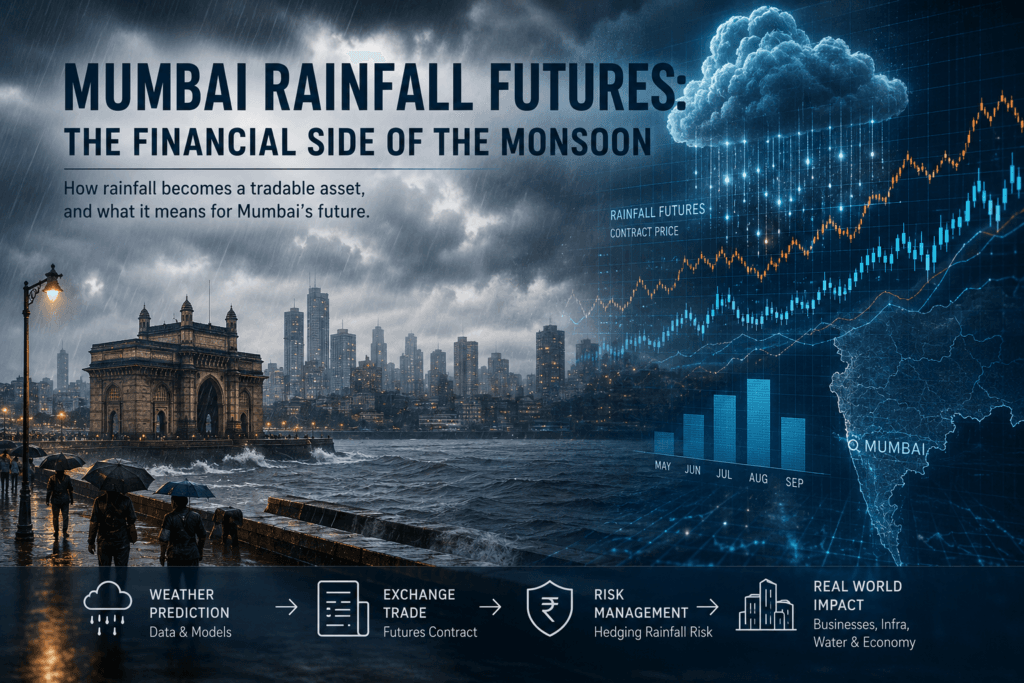
Mumbai is no stranger to torrential rains during the monsoon season, significantly disrupting the city. One prominent example was recorded on May 26, 2025, when the Colaba rain gauge measured 295 mm over a 24-hour period, this marks the highest recorded amount of rainfall, across May months, in the last 107 years. Subsequent “once-every-ten-years” deluges occurred during the monsoon of 2025, recording over 140 mm in 24 hours on August 18, 2025, and again producing 142.6 mm on June.19, 2025. All of these extreme rainfall events overwhelmed the drainage system, leading to flooded neighborhoods (Andheri, Kurla, Ghatkopar, Sion, etc.) and the grounding or immobilizing of vehicular and suburban rail transit. Dozens of aircraft are reported to have aborted landing attempts at Mumbai airport due to aircraft-related problems from runway flooding. The severity and disruptive nature of Mumbai’s annual monsoon rain events present a significant financial and infrastructure risk to businesses, which is why India launched its first exchange-traded rainfall futures (Rainmumbai) on June 1, 2026, enabling businesses to hedge against this risk.
Meteorology
The Indian summer monsoon drives rainfall in Mumbai. The Indian Meteorological Department (IMD) has also indicated that a declining El Niño event will bring Mumbai’s 2026 monsoon rain volume down to approximately 90% of the long-term average (2,240 mm) for the month of June. However, short duration or troughs can produce exceptionally intense precipitation locally. Mumbai is subject to this flooding along with the complicating factors of its coastal profile, four major rivers, and numerous tidal creeks. Significant rain events that occur coincident with high tides produce extremely deep street flooding. Urban factors compound these extreme flooding events, including urban heat islands and the widespread deforestation of rainfall catchments within the city, both enhance convective precipitation rates during intense rainfall (heightened by poor catchment absorption).
Rainfall futures (instrument details)
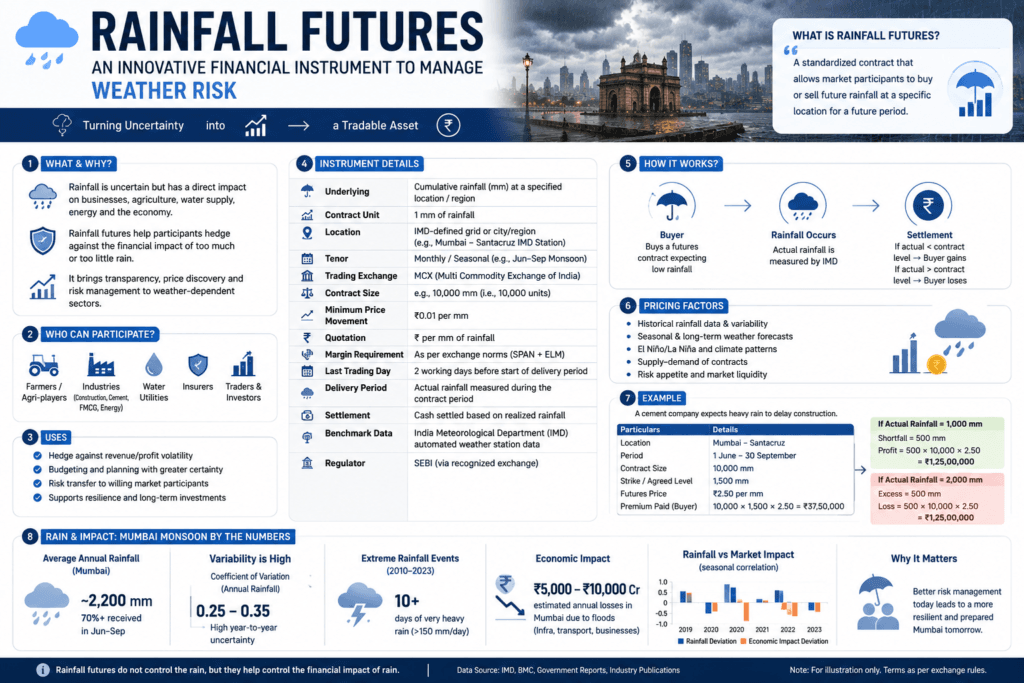
On June 1, 2026, NCDEX began futures trading in RAINMUMBAI. RAINMUMBAI futures are cash-settled contracts based upon rainfall deviation for a month in Mumbai. For purposes of the contract, cumulative deviations from the 30-year average rainfall tracked through the end of June to the end of September (The 30-year IMD average rainfall for the Mumbai monsoon is approximately 2,206.7 mm.) represent the underlying spot value of the contract; 1 mm deviation is equal to the standard price; therefore, it was priced at ₹50 per mm of actual rainfall above or below the long-term average upon which the contracts were based. Consequently, if there is more than normal rainfall in Mumbai during the monsoon, the precipitation index (in mm) will be positive, while if there is less than normal rainfall in Mumbai, the precipitation index (in mm) will be negative. The contract will exist for each month of the monsoon (June to September, 2022) during which the monsoon runs. There is no physical delivery of the contracts; upon contract expiry, NCDEX will determine the spot index using final IMD data and will financially settle the respective gains or losses. NCDEX will be open for trading 10:00 am – 11:55 pm IST Monday through Friday (IST) to accommodate traders worldwide; daily mark-to-market settlements will occur based on the clearinghouse price. All contract trades will be subject to a 6% daily price limit (with a subsequent 3% cooling-off period) based on the previous day’s contract close to limit overall market volatility.
Who buys/sells – hedging examples
New contracts have been introduced which allow “weather sensitive” people to hedge. An example of when this may occur is when a farmer or an agribusiness who fears that the monsoon will be insufficient, may enter into a “long” position by purchasing rainfall futures as a form of hedge against that risk. If actual rainfall is deficient by an amount “X” mm on their farm, then the long position will pay out ₹50×X per lot to offset the loss of the crop. (for example, if the farmer acquires 100 lots anticipating that rainfall will be deficient by 100 mm, and rainfall turns out to be deficient by 100 mm, then the long position will pay ₹5,000 for each of the 100 lots that he bought, which totals ₹500,000). Likewise, hydropower companies or reservoir managers can enter into a long position as a hedge against low inflow to reservoirs. Conversely, a sector affected by excessive rainfall can enter into a long position as a hedge against loss of scheduling due to flooding, such as construction companies or companies in the outdoor tourism industry, while airlines and logistics companies can enter into a long position to protect against scheduling delay losses. In contrast to the long position, short positions are for sellers who expect high rainfall: for example, hydropower companies or farmers in rainfed areas can sell rainfall futures (ensuring that they profit if the actual amount of rainfall exceeds the long-term average and other short sellers incur losses).
Basis/model/counterparty risk
The following caveats apply to the above statements. Basis risk will be present when the weather exposure of the hedger does not correspond to the Mumbai index. For instance, Kolhapur farmers where only local rains occur during this time but whose contract is based on Colaba/Santacruz will experience some non-correlation with their own crop yields due to differences in the data used to create those contracts. Model risk will also be experienced since the design of the contract assumes that the average of all the prior years of LPA is representative of ‘normal’ weather; therefore, with global climate change, this baseline will be moving back and forth for decades to come. The data quality is typically going to be high (>97%) due to the IMD’s official rain-gauge network; however, both reporting delays and corrections can occur. For end-users, counterparty risk is very low since margin accounts will be cleared daily via NCDEX Clearing Limited which means today’s lose by one farmer due to a lack of rain could result in a gain for another trader, thus the margin accounts of the clearinghouse are there to mitigate any loss from defaulting. Unlike the case with OTC weather contracts, these contracts are exchange backed with regulatory protection provided by the SEBI. Therefore, no counterparty credit risk exists because each counterparty has access to a regulated exchange.
Conclusion
The heavy rains in Mumbai recently demonstrated that a wealthy city such as itself still remains extremely susceptible to alterations in climate, which the introduction of the new RAINMUMBAI futures contracts enables businesses to hedge against and make plans for/offset any losses incurred that are associated with drought and/or flooding experiences outside of receiving any sort governmental assistance. In addition to providing an opportunity for hedging, RAINMUMBAI futures help address persistent issues that stem from the lack of reliable data, basis mismatches, and public awareness of what constitutes a climate change event. With climate change creating increased variability in its associated monsoons, then, products such as RAINMUMBAI futures will provide a means for businesses to incorporate climate change-related risks into their everyday economic decisions as well as to support the required infrastructure investment necessary in order to ensure an even greater probability of success in doing so.
Bibliography
- India Meteorological Department (IMD), Rainfall Data and forecasts. https://www.rbi.org.in (basic monsoon norms) and IMD press releases (e.g. southwest monsoon outlook).
- Rajendra Jadhav and Mayank Bhardwaj, “India warns of weakest monsoon in 11 years, inflation risks rise” – Reuters (May 29, 2026). https://www.reuters.com/business/environment/india-expected-have-below-average-monsoon-rains-2026-weather-office-says-2026-05-29.
- Mumbai rainfall reports: Indian Express (e.g. “Mumbai records highest single-day rain in June since 2023”; June 19, 2025). https://indianexpress.com/article/cities/mumbai/mumbai-under-orange-alert-imds-colaba-observatory-records-highest-single-day-rainfall-in-june-10075706/.
- Rediff News (May 26, 2025), “Mumbai breaks 107-yr-old record for May rain” – quoting IMD (Colaba 295 mm). https://www.rediff.com/news/commentary/2025/may/26/mumbai-breaks-107yrold-record-for-may-rain/06c09314920c50f68dc572f60ccf85e1.
- Shilpa Jamkhandikar, “Heavy rain disrupts traffic, floods roads in India’s Mumbai” – Reuters (Aug 18, 2025). https://www.reuters.com/business/environment/heavy-rain-disrupts-traffic-floods-roads-indias-mumbai-2025-08-18/.
- Saurabha Kulshreshtha, “In a first, monsoon rainfall index powers weather derivative trading” – Hindustan Times (May 30, 2026). https://www.hindustantimes.com/cities/mumbai-news/in-a-first-monsoon-rainfall-index-powers-weather-derivative-trading-101780079276141.html.
- Debaroti Adhikary, “Forget stocks, you can now profit from Mumbai rains! Here’s how NCDEX’s unique weather futures work” – The Economic Times (May 21, 2026). https://economictimes.indiatimes.com/markets/stocks/news/forget-stocks-you-can-now-profit-from-mumbai-rains-heres-how-ncdexs-unique-weather-futures-work/articleshow/131244073.cms.
- NCDEX official Rainmumbai futures documents (Contract Specs and Product Note). NCDEX Rainmumbai and related PDFs.
