From Wall Street to War Rooms: How Game Theory Shapes Our Decisions

Game theory is the study of strategic interactions between decision-makers, known as "players," where the outcome for each player depends on the actions of all involved


Game theory is one of the most powerful intellectual tools ever created to understand strategic decision-making. Originally developed by mathematician John von Neumann and economist Oskar Morgenstern in the 1940s, and later revolutionized by John Nash, game theory offers a framework to analyze human behavior whenever multiple decision-makers interact, each with their own incentives and information.

Today, game theory applies to:

  • Capital markets
  • Corporate strategy
  • International relations and war
  • Public policy
  • Cryptocurrencies and decentralized systems
  • Business negotiations
  • Poker and professional gambling
  • Dating, marriage, and friendships
  • Everyday decisions such as “who texts first?” or “should I apologize?”

    As with other influential theories—like behavioral economics, probability, or evolutionary biology—game theory is both rigorously academic and intuitively human. It helps explain why we behave the way we behave.

This article is a deep, yet accessible, walk through Game Theory and its applications, with storytelling, examples, formulas, and even humor to keep things engaging.


1. Game Theory 101: Foundations and Key Concepts

1.1 Strategic Form Games

A strategic-form (or normal-form) game consists of:

  • Players
  • Strategies (actions available to each player)
  • Payoffs (rewards/penalties depending on the chosen strategies)

Formally represented as:

G = {Ρ, S(i), u(i)}

Where:

  • Ρ = set of players
  • S(i) = set of strategies for player 
  • u(i) = payoff function mapping strategies to numerical outcomes

1.2 Nash Equilibrium

A Nash equilibrium (NE) is a set of strategies where no player can unilaterally improve their payoff by changing their decision.
 
This concept was introduced by Professor John Nash, portrayed in the film A Beautiful Mind (2001) starring Russell Crowe.
If readers are curious about the life behind the theory, the movie is a must-watch.
 
To learn Nash equilibrium properly, this Yale lecture is fantastic:
 

1.3 Payoff Matrices and Best Responses
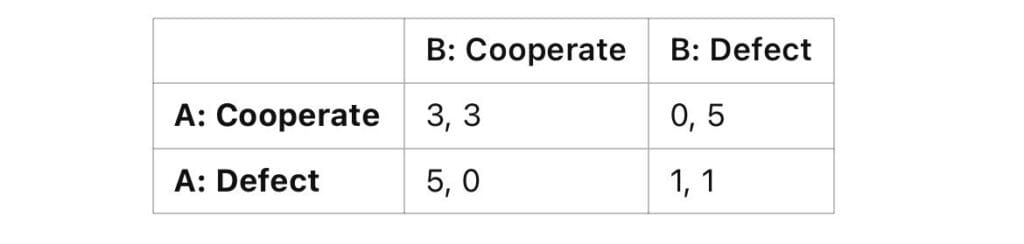
 A simple example:
This is the classic Prisoner’s Dilemma, where the Nash equilibrium is both players defecting (even though cooperation would be better for both).
Game theory is full of these paradoxes—situations where individual rationality conflicts with collective benefit.
 

2. Game Theory in Finance and Capital Markets

 
Financial markets are decentralized systems where millions of actors interact strategically. This makes game theory a natural lens to understand:
 
•Market microstructure
•Predatory trading
•Insider information and signaling
•High-frequency trading
•Oligopoly behavior
•Bidding in IPOs
•Cryptocurrency equilibria
 

2.1 Trading as a Strategic Move

 
For example, in a limit-order book market:
•If a trader posts a large buy order, is it:
• a genuine signal of demand?
• or a bluff to move prices?
 
This resembles poker more than chess.
 

2.2 Market Signaling and “Games of Incomplete Information”

Firms often signal strength through:
 
•Stock buybacks
•Dividends
•Debt issuance
•Public announcements
 
These are Bayesian games, where investors update beliefs based on signals.
Game theory helps price assets by understanding how other players interpret each action.
 

3. Game Theory in Poker: The Art of Strategy Under Uncertainty

 
Poker is one of the purest real-world applications of game theory because:
 
•It has imperfect information (hidden cards)
•It involves strategic deception (bluffs)
•It requires mixed strategies (randomization)
•Payoffs are quantifiable and observable
•Opponents constantly adapt
 

3.1 Poker as a Bayesian Game

Players must form beliefs about opponents’ ranges, not their exact hands.
This is central to game theory: decisions under uncertainty with probability distributions.
 

3.2 Nash Equilibrium and GTO (Game Theory Optimal Play)

A GTO strategy is one that:
 
•Cannot be exploited
•Balances value and bluffing frequencies
•Forces opponents into indifference
 
Example: If your value-bets win 70% of the time, equilibrium often requires bluffing 30% of the time to remain unexploitable.
 
This is pure Nash.
 

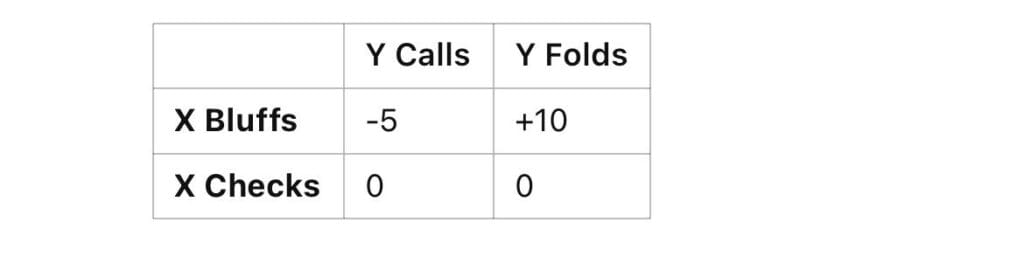
3.3 Simple Bluffing Matrix

Let Player X bet or check.
Player Y can call or fold.
Mixed-strategy equilibrium implies:
•X bluffs some percentage
•Y calls some percentage
 
Neither plays deterministically.
This unpredictability is the strategy.
 

3.4 Expected Value (EV)

EV = Σ (Probability of outcome × Value of outcome)

Because in two-outcome games (like a bluff where you either win or lose), the formula simplifies to:
 
EV = p(win) × W − p(loss) × L
 
This is mathematically equivalent to the full formula when there are only two possible results:
•Outcome 1: Win → payoff = +W
•Outcome 2: Lose → payoff = −L
Then:
EV = p(win) .W + p(loss) . (-L)
 
Which becomes:
EV = p(win) .W – p(loss) . L

This is another important concept that not only poker players understand; it’s also well known among jewelers and sneaker traders, who often use it to negotiate and bargain prices. EV is always present—even when they flip a coin to settle a buying or selling price. Some might argue this is gambling, but hustlers know that with enough volume and over the long run, whether you call it gambling or not, every trade carries risk. There are countless factors outside our control, and movement is king.

Example:

  • Buyer and seller disagree between $13,000 and $16,000 for a ring.

  • They flip a coin.

If the jeweler bought it for less (say $10,000):

  • If he loses (sells for $13k): profit = $3k

  • If he wins (sells for $16k): profit = $6k

Expected value (EV) of a fair coin flip:

EV=3k+6k/2
EV=4.5k 

So on average, if he repeats this many times, the upsides cover the downsides.

This is standard expected-value math.


3.5 Poker as a Microcosm of Life

Poker teaches:
•Bluffing → signaling
•Calling bluffs → risk assessment
•Mixed strategies → unpredictability
•Fold equity → strategic retreat
•Pot odds → investment discipline
 
Few games map so cleanly to human behavior. All of this is and many other practices are the reason why poker players, chess players, and jewelry/watch dealers could become excellent hedge fund managers, quants, and analysts, if they wanted to: the underlying mental model is the same. These fields offer unconventional backdoors into Wall Street.
 

4. Game Theory in International Conflict: The Cold War

The Cold War is essentially a 45-year-long strategic game with:
•Nuclear weapons
•Deterrence
•Escalation
•Incomplete information
•Signaling
•Brinkmanship
 

4.1 Mutually Assured Destruction (MAD)

 
This is a Nash equilibrium.
Neither the U.S. nor the USSR could launch a first strike without guaranteeing their own destruction.
A horrifying but stable equilibrium.
 

4.2 The Cuban Missile Crisis

The crisis can be modeled as a chicken game:
•Both countries escalate (catastrophe)
•One yields, one stands firm (strategic victory for the firm side)
•Both de-escalate (peace but tension remains)
 
Khrushchev blinked first — but only after Kennedy signaled credibly.

5. Game Theory in Relationships and Dating

Game theory is surprisingly useful in understanding:
 
•Who texts first
•Who apologizes first
•Commitment
•Settling vs. searching
•Vulnerability
•Timing
 

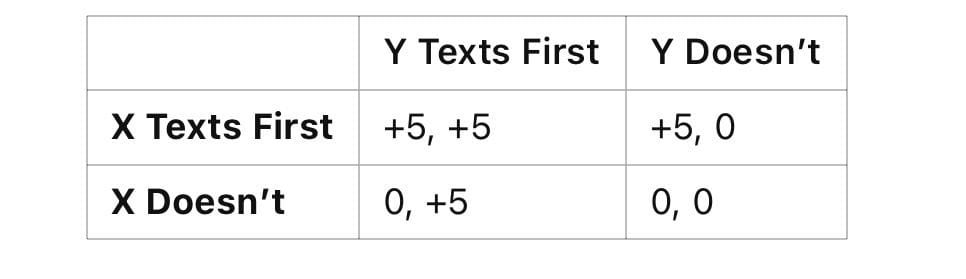
5.1  The “Who Texts First?” Game

 
Let X = man
Let Y = woman
 
Suppose each gains payoff from connection, but risks rejection.
Simple matrix:
This is a coordination game.
The best outcome is someone initiating, but both waiting produces the worst equilibrium.
 

5.2 The Apology Game

Apologizing has a cost to pride but a benefit in relationship stability.
 
Game theory shows that:
 
•If both wait for the other → conflict escalates
•If both apologize → best outcome
•If one apologizes and the other does not → resentment
 
Game theory doesn’t solve emotions, but it explains incentives.
 

Game theory teaches a slightly uncomfortable lesson:

The world is not driven by emotions first — it is driven by strategic expectations of
other people’s behavior.
Markets crash not because we panic.
Wars don’t happen because leaders are “evil”.

The world is a network of strategic interactions, and game theory reveals the hidden logic behind them.

Scroll to Top