India’s 2026 Budget: Why Markets Are Worried About the “Bill”
On paper, India’s 2026 Union Budget looks like exactly what a fast-growing economy needs: more roads, more railways, new technology investments, and expanded support for rural India. Yet financial markets reacted sharply negatively. While the government is focused on long-term growth, investors are uneasy about the short-term arithmetic behind funding this expansion.
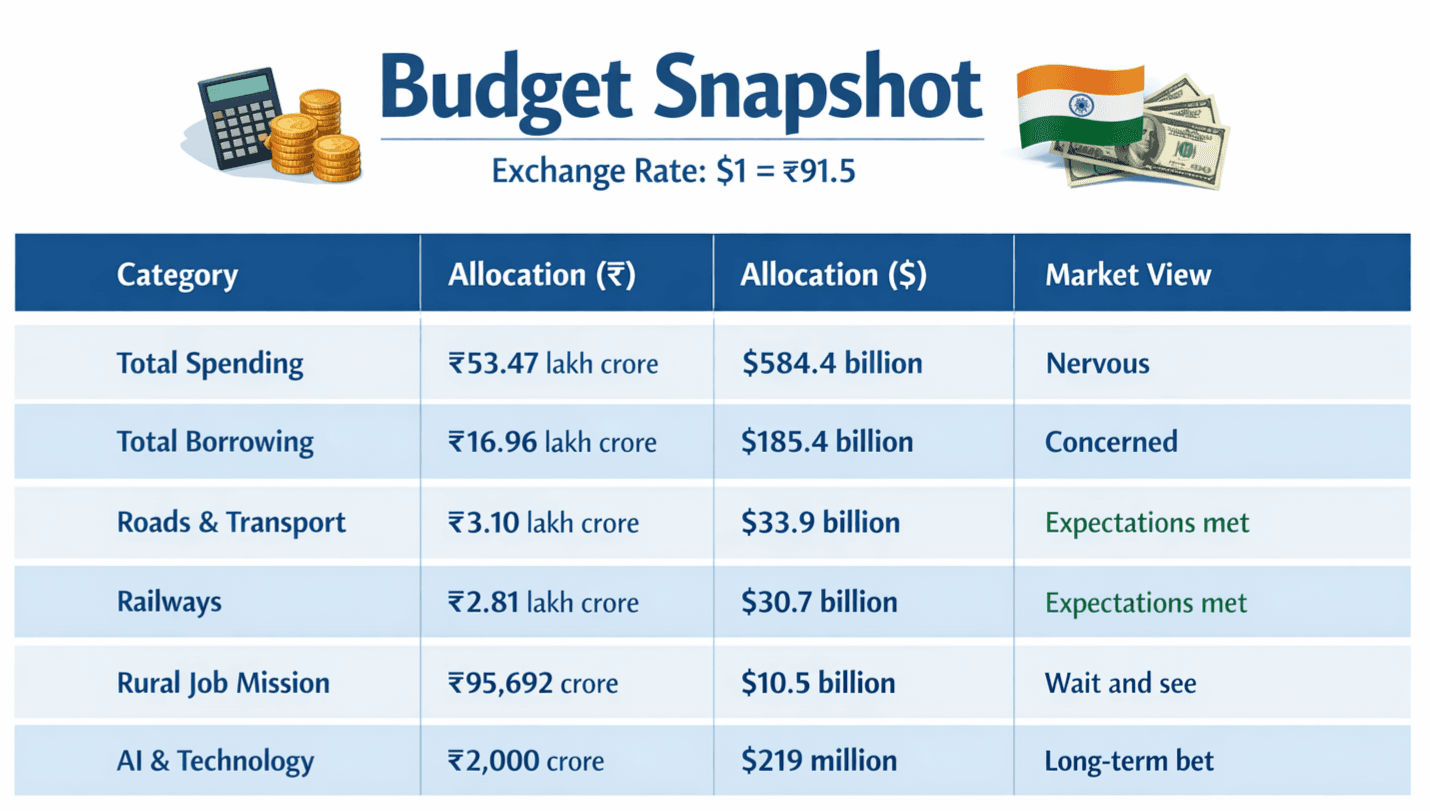
Below is a breakdown of the key announcements—and why markets responded the way they did.
1. The Borrowing Burden: Why Bank Stocks Fell
The government announced a gross borrowing requirement of ₹16.96 lakh crore ($201.9 billion) for FY 2026–27 to fund the gap between its spending and revenues.
Market reaction
PSU Banks: −5.84%
Financial Services: −3.04%
When the government borrows heavily, it competes with private businesses for loans. This can push interest rates higher. Investors worry that higher rates make it more expensive for companies to borrow, reducing future profits. Banks, in particular, face pressure as rising rates and heavy government borrowing can crowd out private credit growth.
2. The Industrial Surprise: Why Metal Stocks Crashed
The budget allocated nearly ₹6 lakh crore ($71.4 billion) toward transport and road infrastructure—normally positive news for steel and cement companies.
Market reaction
Metal Index: −9.95% (the sharpest sectoral decline)
Despite the large infrastructure spend, the budget offered no fresh tax incentives or cost relief for heavy industries facing rising global input prices. Investors chose not to wait for projects to translate into actual demand, leading to aggressive selling in metal stocks.
3. Rural Support Reworked: From MGNREGA to VB-GRAM G
The government reduced direct allocation to the traditional rural employment scheme (MGNREGA) to ₹30,000 crore ($3.5 billion). In its place, it launched a broader rural development mission:
Viksit Bharat – GRAM G (VB-GRAM G) with an allocation of ₹95,692 crore ($11.4 billion).
Market reaction
FMCG (consumer goods) stocks: −0.96%
Consumer goods companies depend heavily on rural households having cash to spend. Markets are cautious because the new mission is less direct than wage-based employment. Investors want proof that the redesigned program will put money into rural hands as reliably as the old system.
4. Transport and Technology: Big Numbers, No Surprises
Key allocations remained largely in line with expectations:
National Highways: ₹3.10 lakh crore ($36.9 billion)
Railways: ₹2.81 lakh crore ($33.4 billion)
AI & Semiconductors: ₹2,000 crore ($238 million)
Market reaction
Infrastructure stocks: −2.66%
Markets had already priced in these investments. When announcements merely meet expectations, traders often book profits. This reflects a classic market behavior: “buy the rumor, sell the news.”
5. Rising Anxiety: The India VIX Spike
The India VIX, often called the market’s “fear gauge,” rose 11.46%. A higher VIX signals uncertainty. Investors are concerned that managing such large borrowing could eventually fuel inflation or force higher interest rates if fiscal discipline weakens.