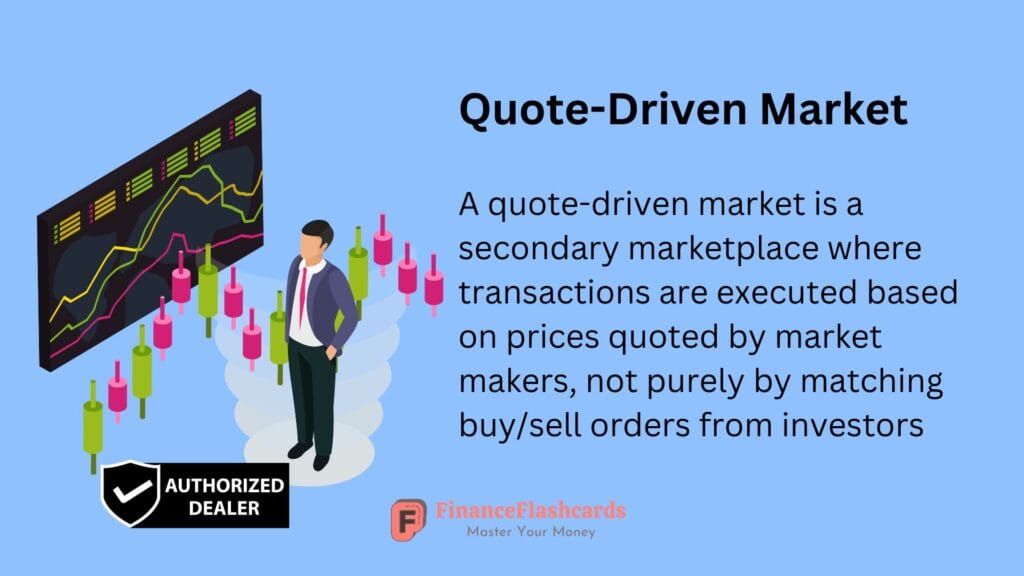
A quote-driven market is a secondary marketplace where transactions are executed based on prices quoted by market makers, not purely by matching buy/sell orders from investors
Table of Contents
What is a Quote-Driven Market?
A quote-driven market is a secondary marketplace where orders are executed based on prices quoted by the dealers/market makers.
In simple words:
You don’t trade with another investor. You trade with a market maker who displays the price at which they are willing to buy (bid) and sell (ask)
Almost all securities, especially bonds, currencies, derivatives and some stocks, trade in a quote-driven market. This is vital for the market as some securities have low trading volume, and it helps ensure liquidity in these instruments.
Understanding a Quote-Driven Market
Quote-Driven is a type of secondary market; it is one of the three market types (the others being an order-driven market and a brokered market).
A quote-driven market operates based on the quoted price from the dealers. It brings more liquidity to the market. Let’s suppose you want to sell a bond, but there is no buyer available, so the dealer will step in and buy the bond at the quoted price(Bid price) and will later sell it to someone willing to buy at the quoted price(Ask price).
Traders may either accept the prices quoted by dealers or negotiate better prices either on their own or through their broker or agent. In a pure quote-driven market, all traders must trade through dealers; however, dealers may also trade among themselves through inter-dealer brokers. In a quote-driven market, dealers provide all the liquidity.
How Quote-Driven Market Works?
In a quote-driven market, orders are executed electronically through dealers, also known as middlemen. They post bids and ask prices for securities and monitor their inventories, resulting in
- Bid Price → Price they are willing to buy at
- Ask Price → Price they are willing to sell at
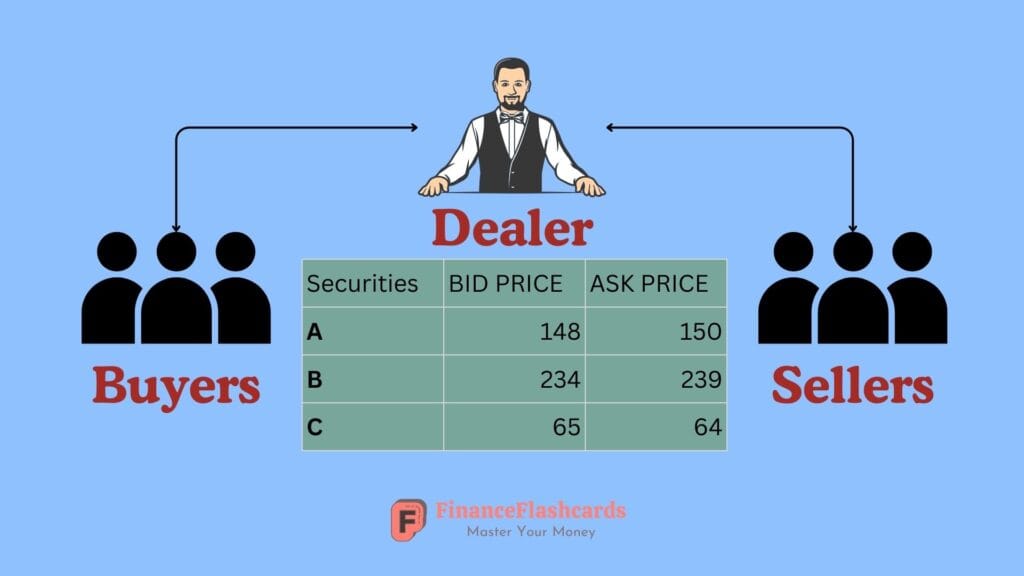
As you can see, a dealer will quote you both the price and the difference between them is known as the spread, and that spread is usually the dealer’s profit.
For example, security A bid price is 148, which means the dealer will pay a maximum of 148 to buy it from a buyer, and its ask price is 150, which means the minimum selling price is 150; the difference of 2 will be the dealer’s profit.
Quote-Driven Market vs. Order-Driven Market and Brokered-Market
The financial market can be broadly classed into three categories: quote-driven, order-driven, and brokered. Each of these markets can be recognised by unique methods of trading and, therefore, different levels of transparency and liquidity.
In an order-driven market, trades are executed based on some fixed rules, where orders of both buyers and sellers are shown, displaying the price at which each is willing to buy or sell a stock and the quantity of the stock that they are willing to buy or sell at that price. Order-driven market is more transparent relative to the other two, but it may be less liquid than a quote-driven market as market makers are not present.
Lastly, a brokered market is one in which brokers serve as middlemen between buyers and sellers. Brokers do not keep securities but link buyers and sellers and charge a commission for their services. In a brokered market, the brokers may locate the best pricing for their customers and offer investors individualised services. A typical example is real estate properties where a buyer and a seller get matched through a broker.
Comparison Between Quote-Driven Market, Order-Driven Market and Brokered-Market
| Feature | Quote-Driven Market | Order-Driven Market | Brokered Market |
|---|---|---|---|
| Who sets the price? | Market makers quote bid & ask prices | Prices discovered through order matching (supply–demand) | Brokers negotiate prices between buyers & sellers |
| Counterparty | Always the market maker | Another investor (through order book) | Another investor (found via broker) |
| How trades execute? | By accepting dealer’s quoted prices | By matching buy & sell orders in the order book | Through negotiation facilitated by a broker |
| Liquidity source | Market makers provide liquidity | Investors provide liquidity | Brokers find liquidity by searching for counterparties |
| Best suited for | Low-volume assets (bonds, forex, OTC) | Highly traded stocks & exchanges (NYSE, NSE) | Very illiquid or unique assets (real estate, fine art, large block trades) |
| Transparency | Lower (dealer quotes dominate) | High (visible order book) | Very low (private negotiation) |
| Trading speed | Fast, instant execution | Fast but depends on matching orders | Slow (depends on broker finding a match) |
| Cost structure | Bid-ask spread | Explicit fees + minimal spread | Brokerage fees/commissions |
| Price discovery | Dealer-driven | Market-driven (most efficient) | Negotiation-based |
| Example markets | OTC bond markets, forex dealers | Stock exchanges like NYSE, NASDAQ | Real estate markets, large block equity trades |
| Participation | Dealer → Investor | Investor → Investor | Broker → connects investors |
| Risk to intermediary | Dealer holds inventory risk | Exchange holds no inventory | Broker holds no inventory (only matching role) |
| Suitable for high-frequency trading? | Yes | Yes | No |
The Bottom Line
Quote-driven markets are one of the most important secondary marketplaces, where a middleman provides liquidity as they buy and sell securities while also keeping the inventory. They often trade low trading volume securities like bonds and forex.
