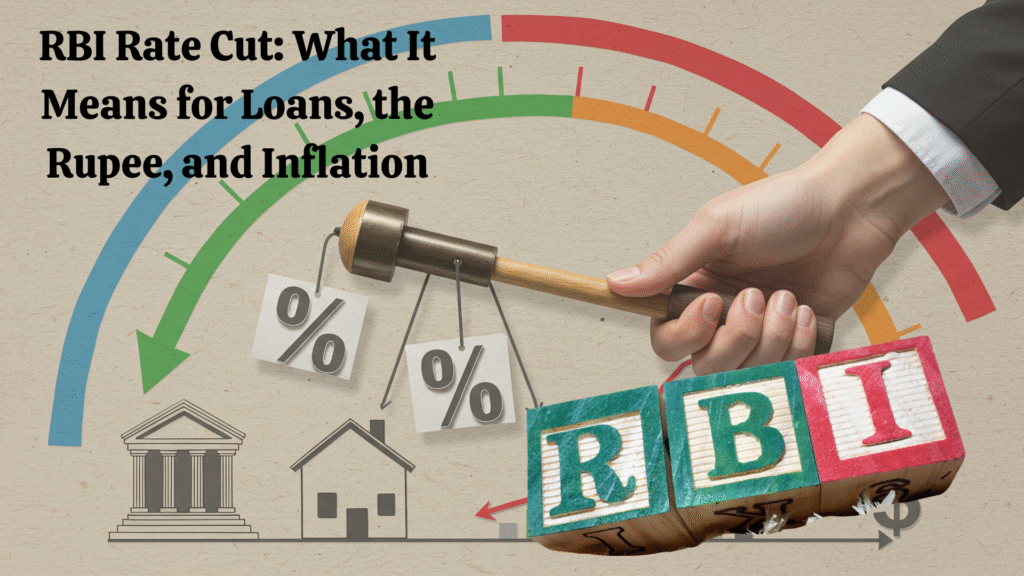

India’s financial markets are navigating a complex landscape as the rupee weakens to fresh lows despite a softer dollar globally. At the same time, Indian equities are struggling to keep pace with stronger earnings momentum and currency stability across North Asia. Leading strategists say the divergence in currency trends and regional performance is shaping a new playbook for investors heading into 2026.
Why the Rupee Is Weakening Despite a Softer Dollar
The rupee’s recent slide has puzzled market participants, given the simultaneous decline in the dollar index. According to experts, the explanation lies in heavy foreign portfolio outflows rather than global currency trends.
1. Foreign Outflows Are Driving the Weakness
Anindya Banerjee, Head of Currency & Commodity Research at Kotak Securities, highlighted on CNBC-TV18 that:
FPIs have withdrawn nearly $2.5 billion from India’s debt and equity markets so far in December.
Rising U.S. bond yields have pushed global investors to rebalance portfolios away from emerging markets, including India.
“When we go deeper…the US bond yields have hardened…we are seeing outflows from the Indian bond market,” Banerjee noted.
2. RBI’s Measured Intervention
Banerjee observed that the RBI is intervening selectively, allowing the rupee to weaken gradually.
With domestic inflation low, the central bank appears comfortable with a softer rupee to support export competitiveness amid a global “trade war environment.”
He suggested that RBI may intervene more aggressively if the rupee approaches the ₹91 per dollar level.
Why India Is Lagging Behind North Asia
The currency strain is coinciding with underperformance in Indian equities relative to North Asian markets.
Manishi Raychaudhuri, CEO of Emmer Capital Partners, highlighted a key framework: earnings, currency, and interest rates are the three variables that influence equity markets. For India:
Interest rates are favorable
Earnings are not keeping pace with expectations
Currency is weakening
Meanwhile, North Asian markets—especially Korea and Taiwan—are outperforming on both earnings strength and currency stability.
“This performance gap is becoming increasingly evident to FIIs,” Raychaudhuri remarked, pointing to recent foreign selling in Indian equities.
North Asia’s Edge: AI Enablers at Attractive Valuations
A major theme driving regional preference is the divergence in the technology sector.
North Asian Hardware Leaders Are Still Cheap
Raychaudhuri noted strong fundamentals in:
SK Hynix
Samsung Electronics
TSMC
These companies sit at the heart of the global AI supply chain—memory, logic, and semiconductor fabrication—and still trade at single-digit P/E multiples even after a robust 2025 rally.
He described them as key “AI enablers” with durable competitive moats and attractive entry points.
Indian IT Seen as “AI Losers” (For Now)
In contrast, Indian IT services firms face structural challenges as traditional outsourcing models undergo disruption from AI automation.
Raychaudhuri said Indian IT remains at risk until these companies reinvent themselves in the new AI-led environment.
Strategy for 2026: Selective Optimism on India
Despite near-term challenges, Raychaudhuri’s firm has shifted to a “marginal overweight” on India within its Asia ex-Japan portfolio, reflecting selective optimism.
Sectors Favored in India
Private Sector Banks
“The outperformance is just beginning,” he said, pointing to improving credit cycles and strong balance sheets.Consumer Discretionary
Autos, healthcare chains, and premium retail are expected to benefit from resilient domestic demand.Conglomerates
Companies like Reliance Industries, which recently received an earnings upgrade, remain strategically well-positioned.Industrials & Infrastructure
Larsen & Toubro
Adani Ports
His thesis rests on government-led capex, global infrastructure spending, and long-term order visibility.
Defence
Rising geopolitical tensions and India’s indigenous manufacturing push make defence a structural, multi-year opportunity.
A New Regional Playbook for Investors
India’s weakening rupee and earnings lag are reshaping the regional allocation strategies of global investors. While North Asia’s technology-driven recovery and valuation appeal continue to draw attention, India still holds long-term promise—particularly in financials, infrastructure, and consumer-focused sectors.
As 2026 approaches, investors must balance India’s domestic strengths with macro headwinds and evolving global opportunities, crafting portfolios that reflect both resilience and regional diversification.