
While headlines celebrate ambitious government spending, trading-floor data tells a far darker story. The Finance Bill 2026 has effectively turned Indian markets into a funding tool for record government borrowing—raising long-term costs for investors, especially new entrants.
The Sensex plunged 1,843 points (-2.28%), but the real warning came from the India VIX jumping 11.46%. This wasn’t a routine sell-off; it signaled a structural rise in market risk and costs.
New Money Is Being Choked at the Door
The sharp hike in Securities Transaction Tax (STT) directly penalizes participation.
Futures sell tax: +150% (0.02% → 0.05%)
Options tax: +50% (0.1% → 0.15%)
What This Actually Means in a Real Trade
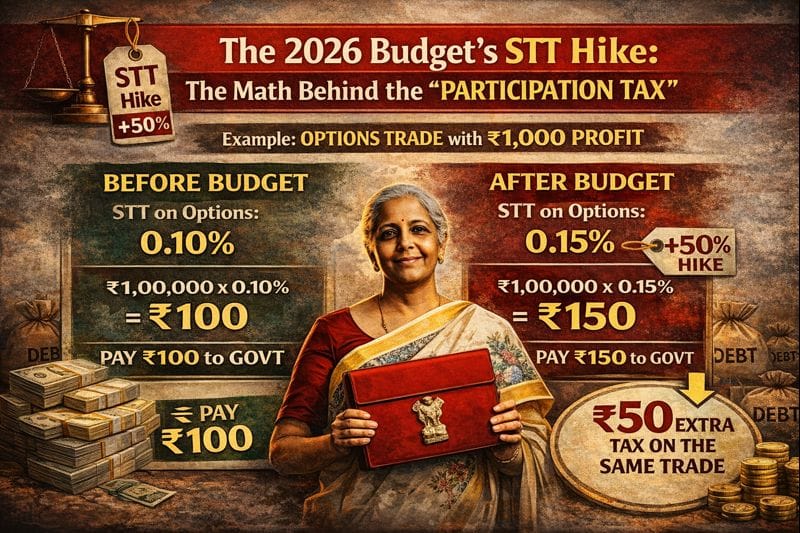
To understand why traders are calling this a “participation tax,” consider a simple options trade. Suppose a trader makes ₹1,000 profit by buying an option at ₹100 and selling it at ₹110, with a total sell-side premium value of ₹1,00,000.
Before the budget, STT on options was 0.10%, resulting in ₹100 paid to the government.
After the budget, STT rises to 0.15%, pushing the tax to ₹150.
That’s an extra ₹50 taken on the same trade, even though the profit hasn’t changed. In percentage terms, 5% of a ₹1,000 profit is now lost purely due to the STT hike. For traders making smaller gains—or trading frequently—this friction compounds quickly, turning marginally profitable strategies unviable over time.
Why This Matters Long-Term
STT is paid regardless of profit or loss, making it fundamentally different from income tax. As trading costs rise, break-even levels move higher, liquidity thins, and fewer participants are willing to deploy capital. Over hundreds of trades a year, this quiet tax erodes returns far more effectively than a one-time levy—especially for retail traders trying to build capital steadily.
Impact:
Higher trading costs raise the entry barrier for retail investors. Every trade now starts deeper in loss, discouraging participation.
Result:
Lower liquidity, wider spreads, and slower wealth compounding over time. New money is being taxed simply for showing up.
Borrowing Bonanza, Private Sector Crowded Out
The government plans to borrow ₹16.96 lakh crore ($202 billion) in FY27.
Massive borrowing absorbs banking-system liquidity
Leaves less credit for private businesses
Keeps interest rates elevated
Market signal:
Nifty PSU Banks: −5.84%
Investors expect PSU banks to park funds in low-yield government bonds instead of financing growth, weakening profitability.
Industrial Exit: Smart Money Pulls Back
The sharpest warning came from heavy industries:
Nifty Metal: −9.95%
Nifty Energy: −3.76%
Commodities: −5.67%
Despite infrastructure promises, capital-intensive sectors are being dumped. High borrowing today means higher funding costs tomorrow—compressing margins for steel, power, and commodity firms.
Sectoral Damage Snapshot
| Index | DTD Move | Market Message |
|---|---|---|
| India VIX | +11.46% | Volatility is here to stay |
| Nifty Metal | −9.95% | Debt will hurt industrial profits |
| Nifty PSU Bank | −5.84% | Banks become govt debt carriers |
| Nifty Fin Services | −3.04% | Higher costs reduce market depth |
Conclusion: A Backdoor Wealth Tax
India’s 2026 Budget quietly changes the math of investing:
Lower returns: Higher STT raises break-even levels
Higher borrowing costs: Loans stay expensive longer
Harder start for beginners: New investors face higher friction from day one
Final Take:
This is a classic “Tax and Borrow” budget. The government is funding growth by taxing market participation today and borrowing heavily from tomorrow. Infrastructure may rise—but the stock market has been assigned the bill. For new money, surviving and thriving just became significantly harder.
