
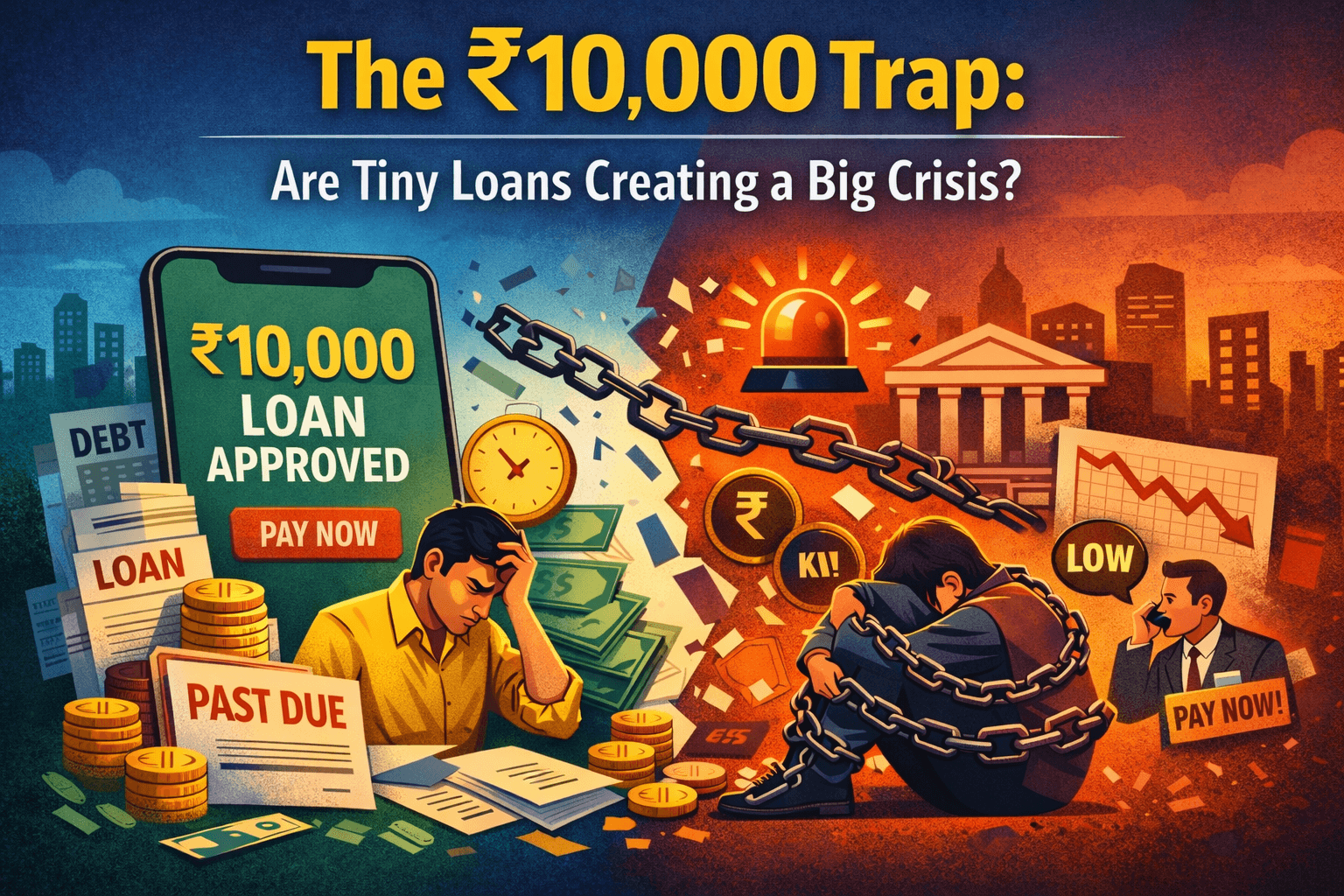
The ₹10,000 Trap : How Tiny Loan Defaults Are Starting to Shake India’s Credit System
At first glance, a ₹10,000 loan looks harmless. It feels too small to cause any real damage. For many borrowers, it’s a quick fix — money to cover rent, a medical bill, or an end-of-month ash shortfall. With digital lending apps offering instant approvals and minimal checks, borrowing has never been easier.
But across India’s credit market, these tiny loans are leaving behind a much bigger footprint.
In recent years, small-ticket digital loans have grown faster than almost any other retail credit segment. According to credit bureau data, loans below ₹50,000 now account for a significant share of new borrower additions. What’s concerning is not the growth itself, but the rising default rates with this category.
Industry reports have consistently shown that delinquencies are highest in short-tenure, unsecured micro-loans, especially those with repayment periods under 30 days. While banks typically see lower default rates in traditional personal loans, digital micro-loans have reported materially higher stress — particularly among first-time borrowers.
The structure of these loans explains why.
Most ₹10,000 loans come with high effective interest costs once processing fees, platform charges, and late penalties are added. While advertised as small loans, their annualized cost often exceeds that of standard personal loans by a wide margin. When repayment dates arrive quickly and income is irregular, borrowers are pushed into rollovers or fresh loans just to stay afloat.
This rollover behavior is now visible in credit data. A growing number of borrowers hold multiple active micro-loans simultaneously, increasing their overall leverage without any corresponding rise in income. As defaults rise, credit scores deteriorate, pushing borrowers further away from formal banking channels and deeper into high-cost lending.
This impact doesn’t stop at individuals.
From a market perspective, rising defaults in the micro-loan segment are beginning to affect overall credit quality indicators. Lenders are being forced to increase provisioning, reassess risk models, and tighten underwriting standards. Several digital lending platforms have already slowed disbursements after experiencing higher-than-expected losses in small-ticket portfolios.
Banks and NBFC’s partnering with fintech platforms are also becoming more cautious. As default data flows into credit bureaus, risk premiums increase. This ultimately leads to higher borrowing costs across unsecured credit, even for borrowers who have stronger repayment histories.
There is also a consumption angle to this issue. Most ₹10,000 loans are used for day-to-day expenses, not asset creation. When households rely on repeated borrowing to fund consumption, it signals income stress. Over time, time weakens consumer spending capacity rather than supporting it, creating a drag on broader economic activity.
Regulators have taken note. The Reserve Bank of India has issued multiple guidelines aimed at tightening digital lending practices, including clearer disclosure of total loan costs, restrictions on unfair recovery methods, and accountability for regulated entities behind lending apps. These steps are meant to curb reckless lending and protect borrowers, but implementation remains uneven.
What makes the situation delicate is scale. Individually, a ₹10,000 default looks insignificant. Collectively, millions of such defaults can distort credit markets, strain lenders’ balance sheets, and undermine confidence in digital credit models that were once seen as the future of financial inclusion.
This tiny loans crisis in India is not about people borrowing irresponsibly. It is about a system that made borrowing extremely easy while making repayment increasingly hard.
Short-term credit, when used occasionally and priced fairly, can be useful. But when high-cost loans become a recurring survival tool, they stop being a solution and start becoming a risk — not just for borrowers, but for the financial system itself.
The ₹10,000 loan isn’t shaking the market because of its size.
It’s doing so because of how often it is taken, how widely it is distributed, and how frequently it is defaulted on.
And this is a trend India’s credit markets can no longer afford to ignore.
