
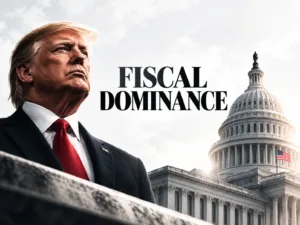
At first glance, this looks like a story about interest rates, US government debt and even gold. But when we go deeper, it lies a much more important question: “What happens when a government’s need to finance its debt begins to influence the environment in which its central bank conducts monetary policy?” This is where the concept of fiscal dominance, central bank credibility and investor confidence become important, and once you start looking at the issue through these 3 lense the debate around interest rates starts looking very differently.
The Debt–Interest Rate Dilemma :
The US government is trying to balance multiple objectives at the same time. They want to maintain government spending and large fiscal deficits, keep borrowing costs manageable, support economic growth and continue attracting investors willing to buy US government debt. Individually none of these objectives are unusual. The problem begins when they start conflicting with one another. A government running large deficits needs to borrow more. More borrowing means more treasury securities entering the market. If investors become concerned about the government’s fiscal trajectory, they may demand higher yields before they are willing to lend. Higher yields, however, make the government borrowing even more expensive. This creates a potentially uncomfortable feedback loop; more debt can lead to higher borrowing costs, which can lead to larger interest expenses, which can create greater fiscal pressure and eventually stronger incentives for borrowing costs to remain manageable.
When Fiscal Policy Meets Monetary Policy
This is where monetary policy enters the picture. The Federal Reserve does not set interest rates according to what is convenient for the U.S. Treasury. Its mandate is centred on maximum employment and price stability. If inflation remains elevated, the Fed may have a perfectly rational reason to keep monetary policy restrictive. But there is a second side to the equation. When government debt is large, higher interest rates have a much greater impact on the government’s finances. This does not mean that the Fed should cut rates simply to reduce the Treasury’s borrowing costs. That would be a serious misunderstanding of monetary policy. The more important question is whether the size of government debt eventually creates an environment in which maintaining sufficiently restrictive monetary policy becomes increasingly difficult because of its broader fiscal and financial consequences.
That is where fiscal dominance becomes relevant. Fiscal dominance occurs when fiscal requirements begin to constrain the practical ability of a central bank to pursue monetary policy independently. It is important to understand that this does not necessarily mean the government directly orders the central bank to cut rates. The Federal Reserve can remain legally and institutionally independent. The problem is much subtler. If government debt becomes sufficiently large, every increase in interest rates creates a much larger fiscal consequence. Monetary policy decisions begin to have enormous implications for government interest expenses, Treasury issuance and financial-market conditions. The central bank may still be independent in a legal sense, but the economic environment in which it operates becomes increasingly influenced by fiscal realities. The question is no longer simply, “What interest rate is appropriate for inflation?” It becomes, “What are the consequences of maintaining that interest rate in a highly indebted economy?”
There is another layer to this problem: markets do not always interpret economic data in the same way policymakers do. Consider a stronger-than-expected employment report. On the surface, strong employment suggests that the economy remains resilient and that the Federal Reserve has less urgency to cut interest rates. But one economic release does not necessarily tell us what is happening underneath the economy. Employment data can be revised, seasonal factors can distort individual readings and temporary changes can sometimes look like structural trends. The Fed therefore has to distinguish between the underlying economic signal and statistical noise. Markets, however, do not always have the luxury of waiting. Investors immediately begin repricing Treasury yields, equities, currencies and interest-rate expectations. This creates what can essentially be called a signal-versus-noise problem. The central bank is trying to understand the economy, while markets are trying to price the future, and sometimes those two processes move at very different speeds.
The Plumbing Behind the Financial System
But the larger issue is not one employment report or one Federal Reserve meeting. It is the debt arithmetic underneath the system. The United States continuously needs to refinance existing debt while issuing new debt to finance fiscal deficits. This makes the Treasury market one of the most important parts of the global financial system. The maturity of that debt also matters. If the government relies more heavily on short-term borrowing, it may benefit from lower financing costs when short-term rates are relatively attractive, but it also becomes more exposed to refinancing risk. The debt has to be rolled over more frequently. If interest rates remain high, that refinancing eventually becomes more expensive. Issuing longer-term debt provides greater certainty over financing costs, but doing so when long-term yields are elevated can lock in those higher borrowing costs for decades. There is no perfect solution. The choice is essentially a trade-off between current financing costs and future refinancing risk.
This is why Treasury issuance, the maturity structure of government debt, the Federal Reserve’s balance sheet, bank reserves and liquidity conditions matter much more than they initially appear to. These are often described as the “plumbing” of the financial system. Most of the time, investors do not pay much attention to plumbing because it works quietly in the background. But when liquidity becomes constrained or financial markets become stressed, the plumbing suddenly becomes extremely important. Movements in the Treasury’s cash balances, changes in bank reserves and the Federal Reserve’s balance-sheet policies can influence the distribution of liquidity across the financial system. The headline policy rate may remain unchanged while the underlying financial conditions are shifting underneath it. In periods of stress, what appears to be a technical issue can quickly become a macroeconomic issue.
What Markets Are Really Signalling
The story also extends beyond Washington because the United States does not finance its government entirely through domestic investors. Foreign central banks, sovereign wealth funds, banks, pension funds and institutional investors are major participants in U.S. financial markets. They hold Treasury securities because the dollar offers something exceptionally valuable: liquidity, scale and access to the world’s deepest capital markets. But foreign investors do not have to make a dramatic political statement to change their view of U.S. assets. They can simply change their portfolios. They can reduce their exposure to long-duration Treasuries, diversify into other currencies, increase allocations to real assets or purchase more gold. Financial markets often communicate through portfolio allocation rather than political statements. Nobody needs to announce that they have lost confidence in the United States. If enough investors gradually decide that the risk-return equation has changed, the market will eventually reflect that decision through prices and yields.
This is where gold becomes particularly interesting. Gold is often described simply as an inflation hedge, but that explanation is incomplete. Gold can also function as a hedge against monetary, institutional and geopolitical uncertainty. A Treasury security is ultimately a financial claim denominated in dollars and backed by confidence in the U.S. government and its institutions. Gold, on the other hand, is not a liability of any government. That makes it attractive when investors become concerned about inflation, currency purchasing power, geopolitical fragmentation or the long-term credibility of monetary institutions. This does not mean that every increase in gold prices proves that investors are losing faith in the dollar. Gold prices are influenced by real yields, central-bank purchases, geopolitical risk, investor positioning and monetary expectations. But persistent demand for gold can still provide information about how investors are thinking about tail risks and the diversification of reserve assets. The interesting question is therefore not simply, “Why is gold going up?” but rather, “Why are investors willing to hold an asset that produces no cash flow?” Sometimes the answer tells us more about investor psychology than about gold itself.
The Real Cost of Managing Debt
Eventually, this leads to an uncomfortable question: what can a heavily indebted government actually do? Broadly speaking, there are two routes. The first is to address the underlying fiscal imbalance through some combination of lower spending, higher revenues, stronger economic growth and productivity improvements. Economically, this is the cleaner solution. Politically, however, it is extremely difficult. The second possibility is to make the existing debt burden easier to carry through monetary and financial mechanisms. This is where inflation and financial repression become important. If a government has borrowed at fixed nominal rates and inflation subsequently remains higher than the interest rate being paid on that debt, the real value of the government’s repayment declines. The government still repays the same number of dollars, but those dollars purchase less. Inflation therefore does not make the debt disappear. It reduces the real burden of the debt. But that cost has to be borne somewhere, and it can ultimately fall on savers, bondholders and holders of the currency through lower real returns and reduced purchasing power.
This is why investors should pay attention not merely to nominal yields but to real yields. A 5% Treasury yield may sound attractive, but if inflation is running at 4%, the economic reality is very different from a world in which inflation is running at 2%. The nominal number tells only part of the story. The real return tells you much more about the actual purchasing power an investor is receiving. This distinction becomes increasingly important in a world where governments have large debt burdens and investors are questioning how those obligations will be managed over the long term.
The Ultimate Constraint: Credibility
And this brings us to the central issue: the real constraint is not simply the size of the debt. It is credibility. Markets can tolerate surprisingly large amounts of government debt when investors believe that the country’s institutions are credible, its economy remains productive and policymakers have a credible path toward stabilising the fiscal position. The United States possesses enormous advantages in this regard. The dollar remains the dominant reserve currency, U.S. capital markets are exceptionally deep and Treasury securities remain among the most liquid financial assets in the world. These advantages should not be underestimated. At the same time, they should not be treated as an unlimited source of protection. Reserve-currency status provides extraordinary flexibility, but it does not eliminate the economic consequences of persistent fiscal deterioration.
If investors begin to believe that fiscal deficits are becoming politically impossible to address, expectations can change. Investors may demand greater compensation for holding long-duration government debt. Treasury yields rise. Higher yields increase the government’s interest burden. The fiscal position becomes more difficult. Political pressure for easier financial conditions increases. Markets then begin asking whether monetary policy can remain sufficiently restrictive if doing so creates increasingly significant fiscal stress. This is where the credibility channel becomes important. The belief that policymakers may eventually be unable or unwilling to tolerate sufficiently high interest rates can itself cause investors to demand a higher risk premium today.
This is why I would not treat fiscal dominance as a binary event where one day the Federal Reserve suddenly “loses independence.” It is better understood as a spectrum of increasing fiscal pressure on monetary policy. Investors should watch the signals before the label becomes obvious. Government interest expenses, Treasury issuance and maturity structure, demand for long-duration Treasuries, real yields, inflation expectations, foreign demand for U.S. government debt, the dollar and gold can all provide pieces of the puzzle. None of these indicators is sufficient on its own. But together, they can tell us whether investors are gradually demanding a larger premium for trusting the institutions behind U.S. financial assets.
At the end of the day, this is not simply a story about whether the Federal Reserve will cut rates next month or whether gold will continue to rise. It is a story about the relationship between fiscal policy, monetary policy and investor confidence. A government can borrow enormous amounts of money for a very long time if investors continue to trust the system behind that debt. But once credibility becomes the binding constraint, the mathematics of debt are only half the story. The other half is expectations.
Markets are ultimately asking a very simple question: “Do I still trust the institutions behind this asset?”
For the United States, that question has global consequences because the dollar is not simply another currency. It sits at the centre of the global financial system. If confidence in U.S. institutions remains strong, the system can absorb a substantial amount of debt. If that confidence gradually weakens, however, the adjustment may appear in places that initially seem unrelated: Treasury yields, the dollar, gold prices, foreign reserve allocations, equity valuations and the cost of capital across the global economy.
And perhaps that is the most important lesson from fiscal dominance.
Debt does not become dangerous merely because it becomes large. It becomes dangerous when investors begin to question the credibility of the institutions responsible for managing it.
The numbers matter.
But eventually, trust matters more.
~ Priyanshu Yadav
https://www.linkedin.com/in/priyanshuyadav-works/